

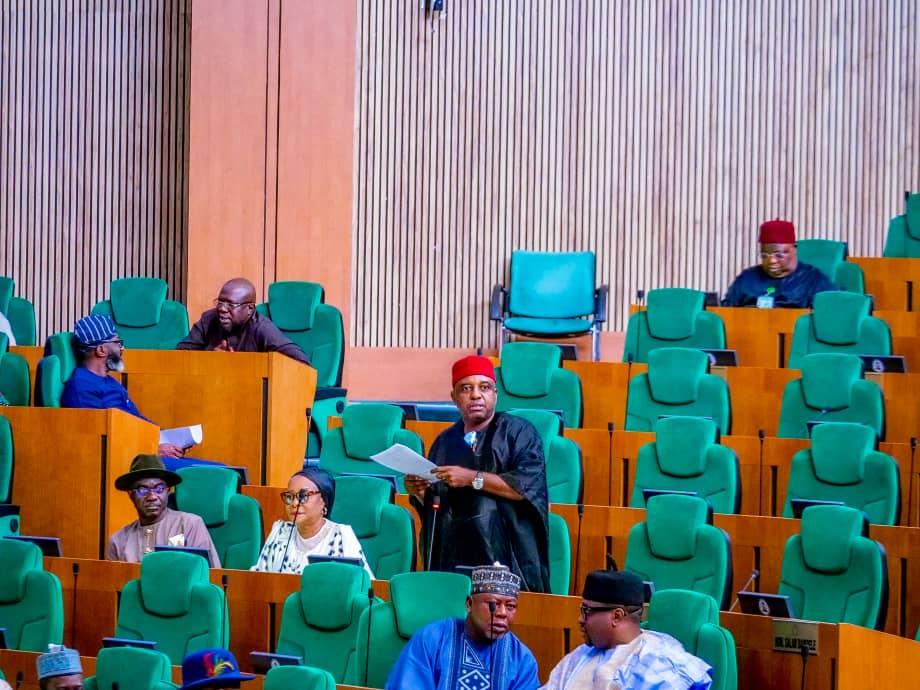
As Nigeria advances under President Bola Ahmed Tinubu’s Renewed Hope Agenda, the drive to transform technical and vocational education is no longer just a policy goal. It has become a national imperative. Amid this wave of progress, one voice is boldly championing a cause that has lingered unresolved for far too long. That voice belongs to Rt. Hon. Emeka Martins Chinedu, the people-centered Representative of Ahiazu Mbaise /Ezinihitte Federal Constituency.
With legislative precision and unshakable resolve, Hon. Chinedu has sponsored the Federal Institute of Technical Education and Skills Acquisition, Mbaise (Establishment) Bill, 2025, officially listed as HB.2342. Popularly known as FITECSA Mbaise, this bold initiative seeks to establish Mbaise as a hub of technical excellence and innovation in a region long underserved by federal presence.
Now that the bill has successfully passed Second Reading in the House of Representatives, it rises beyond the realm of mere proposal. It emerges as a transformative framework poised to correct historical exclusion and ignite youth empowerment, equity, and balanced national development.
Beginning with the 2025–2026 academic year, the Federal Government has eliminated all fees across the 33 Federal Science and Technical Colleges in the country. This groundbreaking reform now guarantees tuition-free education, accommodation, meals, and monthly stipends. It represents a historic shift in the accessibility of technical education across the federation.
Yet behind this major breakthrough lies a painful contradiction. While states such as Kaduna, Bayelsa, Osun, Lagos, Kogi, and Akwa Ibom have Federal Science and Technical Colleges, Imo and Ebonyi, despite being two of the most densely populated and industrious states in the country, have none. Within the South East, Abia, Anambra, and Enugu host federal technical institutions, yet Imo and Ebonyi are conspicuously missing. In the broader national context, Taraba and Zamfara are also similarly neglected. This omission is not just a statistical gap. It is a structural injustice that deprives thousands of young Nigerians of federal opportunity based solely on their geographical origin.
Mbaise, a populous and industrious region, is widely celebrated for its legacy of academic excellence and entrepreneurial energy. It contributes significantly to Nigeria’s non-oil economy through thriving small and medium enterprises. What it lacks is the enabling hand of federal inclusion that transforms raw potential into enduring prosperity.
The sustained exclusion of Imo from federal technical education frameworks is a direct violation of Section 14(3) of the 1999 Constitution, which demands that the composition of government institutions must reflect the federal character of Nigeria and ensure equity across all zones. The absence of such institutions in Imo State undermines national unity and leaves the youth of Mbaise structurally disadvantaged despite their qualifications and zeal.
The lone state-owned technical school in Mbaise has fallen into a state of disrepair after years of underfunding, dilapidated infrastructure, and outdated curricula. Hon. Chinedu views this not merely as a local issue but as a national failure.
He understands that youth unemployment in Nigeria is not a passing statistic. It is a national emergency that weakens families, stifles communities, and burdens the economy. With unemployment soaring above 35 percent and even worse realities in the South East, the absence of federal technical infrastructure in Imo is indefensible. Over 60 percent of Nigeria’s population is under the age of 30. Denying them access to technical education is not just an educational gap but a grave failure of policy.
Studies reveal that every N1 million invested in technical education returns up to N3.5 million in long-term productive output. FITECSA Mbaise is therefore not only a moral obligation but a sound economic strategy. The bill is in harmony with Nigeria’s key development policies, including the National Skills Qualification Framework, the Economic Recovery and Growth Plan, and the Renewed Hope Agenda. These frameworks all prioritize entrepreneurship, youth development, and institutional equity.
The urgency is further highlighted by the recent federal approval of a N45,000 monthly stipend for students in technical colleges. While commendable, this initiative exposes a contradiction. In the absence of a federal technical institution in Imo, the youth of Mbaise remain excluded. Not for lack of talent or interest, but simply because the access point does not exist. Geography, not merit, becomes the gatekeeper to opportunity.
Consider the story of Ndukwu, a 22-year-old Mbaise graduate. “Without affordable technical training,” he recalls, “I was forced into menial jobs that could never match my potential. If a federal institute had existed here, I would be running my own business by now.” His voice is one among thousands of voices of resilience stifled by systemic omission.
Hon. Emeka Martins Chinedu has consistently exhibited a leadership style grounded in purpose, vision, and results. He is not merely raising a constituency complaint. He is articulating a national solution. The Mbaise Institute Bill is a forward-thinking, data-driven, and nationally relevant blueprint for closing the skills gap and extending the reach of technical education to the underserved.
Across the world, countries like Germany, South Korea, China, and Brazil have unlocked economic transformation by investing heavily in technical and vocational education. Brazil’s federal institutes have trained millions and uplifted entire regions. Nigeria can walk this path. But it must begin by investing in places it has long ignored.
As this bill progresses through legislative channels, Nigeria stands at the threshold of a generational opportunity. Hon. Chinedu has offered not just legislation, but a moral compass and a developmental roadmap anchored in fairness and urgency.
The moment has come for all stakeholders to stand in firm and collective advocacy. Lawmakers across party lines, traditional rulers, faith leaders, youth movements, civil society organizations, academics, media platforms, and patriotic Nigerians in the diaspora must raise a single voice. This is not a provincial ambition. It is a call for national justice and intentional inclusion.
Hon. Emeka Martins Chinedu’s vision is not only compatible with the goals of the Federal Government. It is an emphatic extension of them. President Bola Ahmed Tinubu’s courageous reforms, including the abolition of fees, introduction of student stipends, and support for vocational training, have already laid the foundation for a more equitable Nigeria. What remains is to ensure that no region, no community, and no child is left behind.
Mbaise must be part of this new dawn. Let FITECSA Mbaise rise as a shining testament of how national vision can be translated into local empowerment. Let this moment be the turning point when the National Assembly, the Executive, and every well-meaning Nigerian affirm that the Renewed Hope Agenda is not just a slogan but a lived reality for all.
In advancing this bill, Hon. Emeka Martins Chinedu is not simply fighting for his constituency. He is amplifying the President’s legacy and deepening the promise of a greater, more inclusive Nigeria. The time to act is now.
The Mbaise Institute Bill is not a mere legislative document. It is a moral imperative, a constitutional necessity, and a developmental lifeline. Let the 2026 federal budget boldly reflect this urgency. Let FITECSA Mbaise rise, not only as a physical structure but as a national monument to fairness, equity, and progress. Let it proclaim that no Nigerian shall be denied opportunity because of their place of origin.
As John F. Kennedy profoundly observed, “A rising tide lifts all boats.” Let us raise Mbaise, and in doing so, elevate the destiny of Nigeria itself.
- Nnamdi Ukasanya, Special Adviser on Media and Publicity to Hon. Emeka Martins Chinedu (MHR)
