

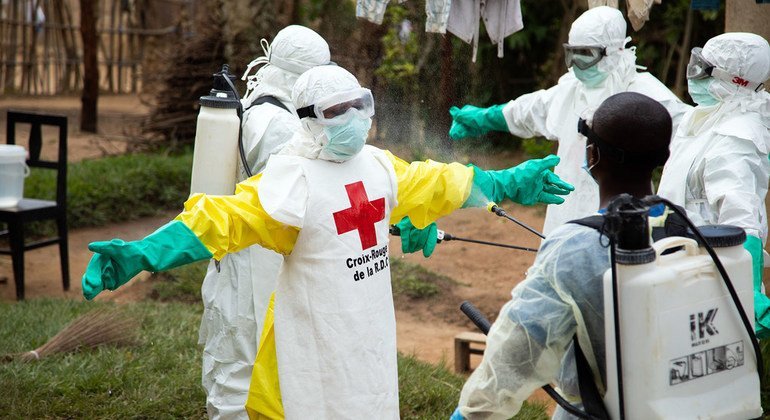
The Federal Government said it had intensified monitoring and screening procedures at all points of entry in response to the ongoing outbreak of the Ebola Virus Disease in the Democratic Republic of Congo.
The Director of Port Health Services at the Federal Ministry of Health and Social Welfare, Dr Akpan Nse, disclosed this in an exclusive interview with Saturday PUNCH on Friday. Nse also noted that additional staff had been employed to strengthen border surveillance in the country.
Health authorities in the Democratic Republic of Congo declared an outbreak of Ebola virus disease in Kasai Province, where 28 suspected cases and 16 deaths, including four health workers, had been reported as of September 5, 2025.
The outbreak comes at a time when much of Central and West Africa is grappling with overlapping health and humanitarian crises, including cholera, malnutrition, and population displacement. The DRC’s last outbreak of Ebola virus disease occurred in the north-western Equateur Province in April 2022.
It was brought under control within three months. In Kasai Province, previous Ebola outbreaks were reported in 2007 and 2008. Overall, the country has experienced 15 outbreaks since the disease was first identified in 1976.
Ebola virus disease is a rare but severe, often fatal illness in humans. It is transmitted to people through close contact with the blood, secretions, organs, or other bodily fluids of infected animals such as fruit bats (believed to be the natural hosts). Human-to-human transmission occurs through direct contact with the blood or bodily fluids of an infected person, contaminated objects, or the body of someone who died from the disease.
In the ongoing outbreak, samples tested on September 3 at the National Institute of Biomedical Research in the capital, Kinshasa, confirmed that the cause was Ebola Zaire, a strain of the Ebola virus.
Dr Nse noted that although Nigeria was at risk of importing the virus due to high levels of international travel with the DRC, Port Health Services was on alert and had strengthened surveillance to prevent this.
He said, “We have intensified surveillance at all points of entry across the country—airports, land borders, and seaports. Every inbound traveller coming from Congo to Nigeria is thoroughly screened, and we collect their medical history through mandatory forms.
“We have also reactivated our portals. Every passenger on every flight coming to Nigeria from Congo is screened upon arrival. This applies to airports, seaports, and land borders. Even if passengers transit through Congo on their way to Nigeria, they must undergo screening.
“In addition, with support from WHO, we have recruited more staff to enhance surveillance. Increasing the workforce allows us to effectively prevent the importation of the virus and ensure thorough screening at all borders.”
He added that some private organisations had partnered the Federal Government to ensure that thermal scanners at airports remained fully functional.
Meanwhile, the WHO has released $500,000 from its Contingency Fund for Emergencies to support the response to the Ebola Virus Disease outbreak in the DR Congo. Announcing this at a media briefing on global health issues on Friday, the WHO Director-General, Dr Tedros Adhanom Ghebreyesus, disclosed that 28 suspected cases and 16 deaths had been reported so far, including four health workers.
He highlighted that the UN body already had staff on the ground in Kasai, with more on the way. “We’re joining rapid response teams to trace contacts and find cases; we’re collecting and testing samples, and we’re providing technical expertise in surveillance, infection prevention and control, treatment, risk communication, and more. WHO has also delivered personal protective equipment, laboratory equipment, medical supplies, and a mobile laboratory.
“We had previously prepositioned 2000 doses of Ebola vaccine in Kinshasa, which we are releasing to vaccinate contacts and health workers. This is the 16th outbreak of Ebola in the DRC, and the government has rich experience from those previous outbreaks,” the WHO boss stated.
Fresh Ebola outbreak kills 15 in DR Congo
Meanwhile, a fresh Ebola virus disease outbreak in the Kasai Province of the Democratic Republic of Congo has resulted in the death of 15 persons, according to reports by health authorities. 28 cases have been reported with four health workers falling victim to the disease, as of September 4, 2025.
Places affected include Bulape and Mweka health zones in Kasai Province where health officials have been carrying out investigations. Findings show symptoms such as fever, vomiting, diarrhoea and haemorrhage in death and reported cases, as tested samples at the country’s National Institute of Biomedical Research confirmed the cause of the outbreak to be Ebola Zaire.
A national Rapid Response Team, including World Health Organisation (WHO) experts, was deployed to Kasai Province to aid in disease surveillance, treatment, and infection prevention and control. Provincial risk communication experts have also been deployed to create awareness.
Dr Mohamed Janabi, WHO Regional Director for Africa said the organization was working rapidly to contain its spread. “We’re acting with determination to rapidly halt the spread of the virus and protect communities.
“Banking on the country’s long-standing expertise in controlling viral disease outbreaks, we’re working closely with the health authorities to quickly scale up key response measures to end the outbreak as soon as possible,” he said.
“Case numbers are likely to increase as the transmission is ongoing. Response teams and local teams will work to find the people who may be infected and need to receive care, to ensure everyone is protected as quickly as possible,” WHO added. The country is said to have a stockpile of treatments to vaccinate contacts and frontline health workers.
The last outbreak of Ebola in the country affected the north-western Equateur province in April 2022 and was brought under control within three months. While the disease is rare, it is often severe and fatal in humans and transmitted through close contact with the blood, secretions, organs or other bodily fluids of infected animals like fruit bats, often considered as natural hosts.
For Human-to-human transmission, it is often through direct contact, or objects contaminated with blood or body fluids of a person who is sick with or has died from Ebola. Fresh Ebola outbreak kills 15 in DR Congo, WHO, health authorities raise alert. A fresh Ebola virus disease outbreak in the Kasai Province of the Democratic Republic of Congo has resulted in the death of 15 persons, according to reports by health authorities.
28 cases have been reported with four health workers falling victim to the disease, as of September 4, 2025. Places affected include Bulape and Mweka health zones in Kasai Province where health officials have been carrying out investigations.
Findings show symptoms such as fever, vomiting, diarrhoea and haemorrhage in death and reported cases, as tested samples at the country’s National Institute of Biomedical Research confirmed the cause of the outbreak to be Ebola Zaire.
A national Rapid Response Team including World Health Organization (WHO) experts was deployed to Kasai Province to aid disease surveillance, treatment and infection prevention and control. Provincial risk communication experts have also been deployed to create awareness.
Dr Mohamed Janabi, WHO Regional Director for Africa said the organization was working rapidly to contain its spread. “We’re acting with determination to rapidly halt the spread of the virus and protect communities.
“Banking on the country’s long-standing expertise in controlling viral disease outbreaks, we’re working closely with the health authorities to quickly scale up key response measures to end the outbreak as soon as possible,” he said.
“Case numbers are likely to increase as the transmission is ongoing. Response teams and local teams will work to find the people who may be infected and need to receive care, to ensure everyone is protected as quickly as possible,” WHO added.
The country is said to have a stockpile of treatments to vaccinate contacts and frontline health workers. The last outbreak of Ebola in the country affected the north-western Equateur province in April 2022 and was brought under control within three months.
While the disease is rare, it is often severe and fatal in humans and transmitted through close contact with the blood, secretions, organs or other bodily fluids of infected animals like fruit bats, often considered as natural hosts. For Human-to-human transmission, it is often through direct contact or objects contaminated with blood or body fluids of a person who is sick with or has died from Ebola.
