

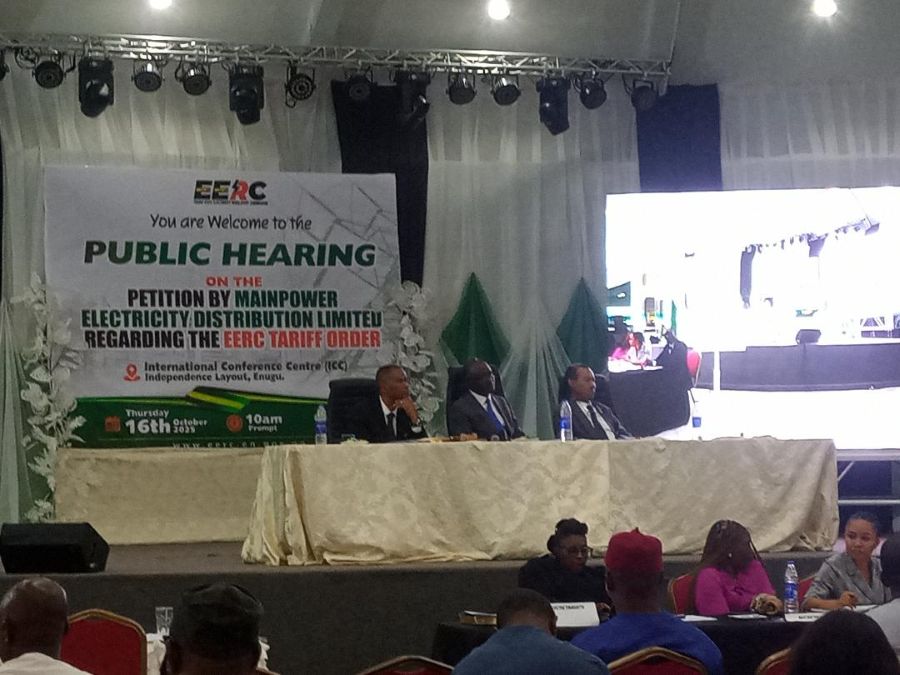
Participants during the Public Hearing on electricity tariff order at ICC, Enugu…Photo Credit: NewsBits
The Enugu Electricity Regulatory Commission (EERC), on Thursday, organised a public hearing on the petition filed by MainPower Electricity Distribution Limited, which is praying for a review of the Commission’s Tariff Order issued in July 2025.
NewsBits reports that the hearing, which was held at the International Conference Centre (ICC), Enugu, was attended by major stakeholders in the state’s power sector, including representatives of the Association of Nigerian Electricity Distributors (ANED), consumer advocacy groups, and regulatory officials.
The Chief Executive Officer of the Enugu Electricity Regulatory Commission, Chijioke Okonkwo, who addressed the gathering, pinpointed the historical and regulatory context that caused the current tariff structure.
Okonkwo recounted that following the enactment of the Electricity Act, 2023, which empowered states to regulate electricity generation, transmission, and distribution within their territories, Enugu State, for that reason, established its own regulatory framework.
The CEO of the EERC also explained that the Enugu State government first prepared a policy document, which led to the passage of the Enugu State Electricity Law, specifically designed for the benefit of Enugu citizens.
He said: “Pursuant to that law, commissioners for the Enugu Electricity Regulatory Commission were appointed, enabling the state to formally seek regulatory transfer from the Nigerian Electricity Regulatory Commission (NERC).”
He said that Enugu officially assumed full regulatory responsibility for electricity services on October 22, 2024, after a six-month transition period approved by NERC.
Okonkwo further saide that part of the transition process required the creation of MainPower Electricity Distribution Limited, a subsidiary that took over the assets, liabilities, and operations of the Enugu Electricity Distribution Company (EEDC) within the state.
He said: “We subsequently licensed MainPower and issued it a tariff order governing electricity operation in Enugu State…That order, issued on July 18, 2025, and effective August 1, 2025, was the result of extensive assessment and fair consideration of the company’s assets and liabilities.”
According to him, the ₦160 per kilowatt-hour tariff was “prudently determined” after examining various cost parameters, including customer numbers and distribution efficiency.
Okonkwo further said: “However, MainPower later petitioned against the order, expressing disagreement with some of the assumptions and parameters used…We considered it inappropriate to amend the order unilaterally and instead opted for this public hearing in line with our business rules — to ensure transparency, fairness, and public participation.”
In his presentation, the Managing Director, MainPower Electricity Distribution Limited (MEDL), Dr. Ernest Mupwaya, argued that the EERC did not follow due process in issuing the July 18, 2025, tariff order.
The company maintained that the Commission ignored its own business rules by releasing a tariff order without a bilateral agreement between both parties and by “cherry-picking numbers” that did not reflect operational realities.
According to Mupwaya, “An independent audit firm, KPMG, reviewed the process and confirmed that the parameters used by EERC were wrong. We urge the Commission to adopt the actual data presented to it, rather than assumptions, to ensure a fair and sustainable tariff framework.”
The MEDL argued that the current ₦160/kWh tariff was inconsistent with prevailing costs in the national electricity market and was unsustainable for its operations.
Supporting MainPower that EERC’s tariff reduction was arbitrary, Barr. Sunday Oduntan, Chief Executive Officer of the Association of Nigerian Electricity Distributors (ANED), cautioned against setting tariffs below the actual cost of energy supplied to the state.
Oduntan said, “In this industry, we are distributors, not generators. We buy electricity from those who produce it, and there is always a landing cost associated with that product.”
The CEO of ANED pointed out that while the Electricity Act 2023 allows states to regulate electricity within their borders, they must still respect market realities when sourcing power from the national grid.
According to Oduntan, “Until Enugu begins generating its own electricity — for instance, from coal — it cannot fix arbitrary prices for a product that comes from outside its borders. The cost must reflect the true landing cost, which the NERC currently calculates at about ₦209 per kilowatt-hour for Band A customers.”
He cautioned against setting tariffs below cost as such could reintroduce the burden of subsidies. He said: “If the cost price is higher than the regulated price, we must ask who pays the shortfall — are we going back to the era of subsidy?”
Worried by high electricity tariff, the South-East Electricity Consumers Association (SEECA), in its submission to the Commission, strongly opposed MainPower’s petition, stressing that the ₦160/kWh tariff should be retained.
In a memorandum signed by its Enugu State Chairperson, Patience Ifebuche Chukwu, SEECA insisted that the EERC followed due process and provided a fair hearing before issuing the tariff order.
SEECA said: “Records show that before the Tariff Order was made, a series of meetings and submissions were held between EERC and MainPower. Fair hearing is not an automatic principle to be invoked at convenience. A party that had the opportunity to be heard cannot later claim denial.”
SEECA dismissed MainPower’s claim of ₦1.3 billion monthly losses, arguing that electricity consumers had endured greater hardships due to erratic power supply, estimated billing, and poor service delivery.
According to the association, “Consumers have suffered loss of lives, spoiled goods, and business closures. These losses far outweigh any purported loss claimed by the petitioner.” The SEECA pleaded for the quick abolition of the controversial Band classification system, which it regarded as “discriminatory.”
SEECA recommended that if any review must be done, the tariff should not exceed ₦165/kWh.
As a way out of the logjam, the EERC said the submissions made at the public hearing would be thoroughly reviewed before any final decision would be taken on the petition.
However, Okonkwo reaffirmed the Commission’s commitment to balancing the interests of both operators and consumers through “fair, transparent, and evidence-based regulation.”
He said: “Our goal is to ensure that operators receive fair value for their services while consumers get commensurate value for every naira they pay. Whatever decisions we make will be guided by fairness, transparency, and sustainability.”
