

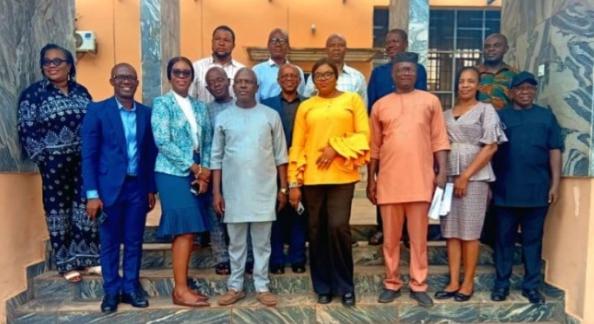
Participants with resource persons at the workshop
By Tony Adibe
The Resource and Environmental Policy Research Centre, Environment for Development (REPRC-EfD), Nigeria, University of Nigeria, Nsukka, has advised journalists in the country to focus more on critical environmental issues so that the Federal Government and National Assembly would adopt better ways of tackling the country’s environmental challenges.
The Centre said that it was not proper for journalists to always wait until environmental disasters of high magnitude occurred before they could highlight such in the media. The Director, REPRC-EfD Nigeria, Prof. Nnaemeka Chukwuone, gave the advice in his opening remarks during a one-day training workshop for journalists on environmental matters, held at the University of Nigeria, Nsukka, on Thursday. Participants were drawn from Nigeria’s SouthEast geopolitical Zone.
“We want a situation in which the media will always partner with the EfD Nigeria and amplify the results of the research conducted by our Research Centre so that the policy makers will see its merit and adopt it in tackling the menace of environmental challenges facing our society,” said a Professor of Economics at UNN, and also the Deputy Director, EfD Nigeria, Prof. Abanum Innocent Ifeduninu, who represented Chukwuone on the occasion.
He emphasised the urgent need for the media, at all times, to amplify and promote the activities of the Research Centre, adding that there should be a partnership between the media and the EfD, Nigeria. “We want the media to highlight the outcome of the research from the Centre so it will get to the policymakers and or the authorities in Nigeria,” he said.
“We want the activities of the Research Centre to be well disseminated. We want to ensure a partnership with the media because of the crucial role of the media,” he re-emphasised.
In a lecture, “Interpreting Environmental Research For Public Communication: Bridging The Gap Between Science and Society,” Prof. Luke Anorue of the Department of Mass Communication, UNN, said that “research is at the heart of social existence,” stressing that there wouldn’t be the existence of knowledge without research.
Prof. Anorue described research as the backbone of development in society but regretted that the low pace of development in Nigeria was due to the inability of the government to energise research. “The outcome of research can’t impact on society, except the media amplifies the result; hence, the result of our research has to be highlighted for wider spread to policy makers and the authorities to make use of it,” he said.
The university don, however, cautioned journalists against sensationalising and or wrong interpretation of results, which, he stressed, could lead to more confusion in society. “A wrong interpretation of results could arise from the wrong use of words or language. This could create confusion,” he said.
In a second paper titled, “Environmental Challenges in Nigeria and The Role of REPRC-EfD Nigeria in Providing Evidence-based Solutions,” a Research Fellow at the REPRC-EfD, Nigeria, Dr Chizoba Oranu, argued that Nigeria’s environmental crisis was no longer distant or abstract but rather happening on a daily basis in different ways before our eyes.
She said that as the gatekeepers to the public in information dissemination, journalists have a critical role to play in spreading information on environmental crises that occur daily in various ways in society.
She said: “Journalists need to take a step further to do more in tackling environmental damage, such as health problems arising from pollution in the environment. It could be air pollution, water pollution, land pollution, and how these things impact our people. The journalists should attempt to go beyond the disasters, tragedies and report on the system failures. There should be a continuous sensitisation of society on the issue at stake. Only sustained reportage can bring a change in behaviour. Journalists should embark upon environmental advocacy on why people should not dump waste indiscriminately.”
Earlier, the Communication Officer, REPRC-EfD Nigeria, Mr. Inya Agha Egwu recalled that the first of this kind of training was held three years ago, adding that henceforth, the Centre would consider making it more periodical. “It’s not going to be a three-year affair. We are going to see how it can be made more regular,” Egwu said, recalling that the first phase of the training was attended by only journalists from Abuja, Lagos, and Enugu.
Egwu explained that the essence of the training focused on how journalists could pay particular attention to environmental issues. “The essence of this training is to acquaint us with the knowledge we need to report effectively the issue of environment; where research comes in, and efforts being made to ensure that the reports are disseminated to the concerned people,” said Egwu, who also noted that the “Centre is actively involved in environmental and policy research. And in doing our research, we ensure that all the stakeholders are involved.”
According to the Communication Officer, in the EfD Nigeria, “we make sure that every research we do is policy centred. We discovered that without the active involvement of the media, the result of the research would not be known to the public.”
Egwu, however, later presented the third lecture, tagged: “Data Journalism and the Use of Infographics in Environmental Reporting.” Delivering his paper, he highlighted the importance of data and how it could be used to add more credibility to reports on environmental challenges. “With the correct data and charts, or a map, it will be difficult for anyone to doubt your story,” said Egwu, who encouraged the participants to cultivate the art of using data in telling their environmental stories.
