

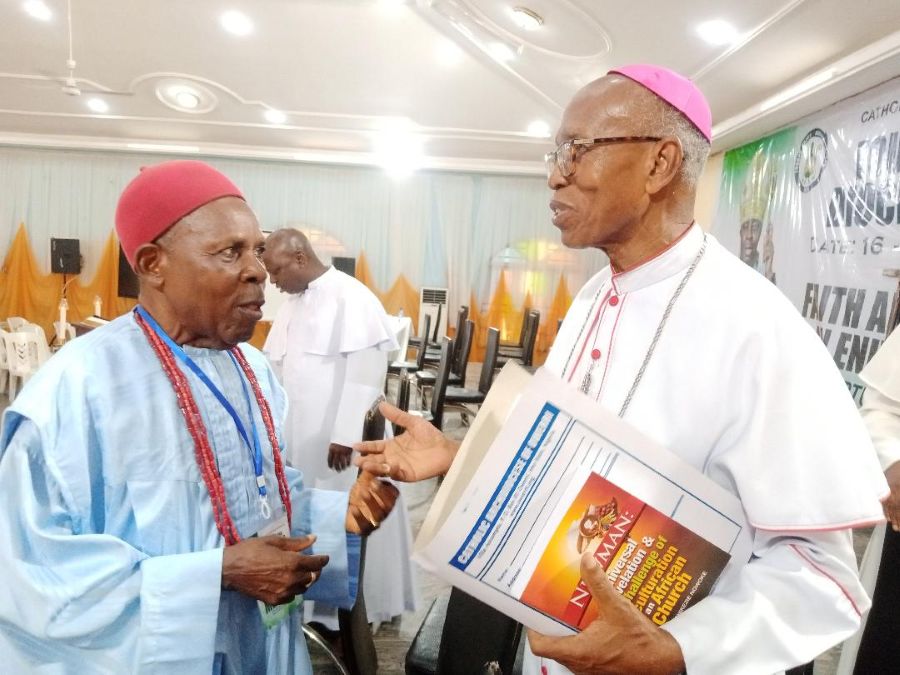
Archbishop Emeritus Anthony J.V. Obinna (r) discussing with Igwe Lawrence Agubuzu shortly after the lecture
By Tony Adibe
The infamous Osu Caste System which has literally stuck to the Igbo like leprosy, despite their acclaimed Christianity, has raised its ugly head again, causing hot debate among participants during a public lecture.
This was as the popular Catholic Archbishop Emeritus, Most Rev. Anthony J.V. Obinna of the Assumpta Cathedral, Owerri Diocese, presented the lead lecture for the day inside the Jubilee Hall at the Holy Ghost Cathedral, Enugu during the 4th Enugu Catholic Diocesan Synod.
Archbishop Obinna’s 37-page lecture pamphlet, produced in thousands of copies and distributed to the entire participants, was titled, “The Problem of OSU & OHU in our communities & The AMADI/DIALA Linkage: Uniting God’s Igbo Children – Njikozi Igbo Umu Chukwu.”
The lecture, which earned Obinna a standing ovation, perhaps, raised much dust than any other during the one-week synod convoked by his Lordship, Most Rev. Callistus V.C. Onaga, Catholic Bishop of Enugu Diocese, NewsBits learnt.
NewsBits recalls that the challenge of the osu phenomenon has been with the Igbo for centuries, and it is not certain when, and if it will end.
The Synod in session
Also recall that the late world-acclaimed novelist, Prof. Chinua Achebe, hinted at the Osu challenge in his second novel, “No Longer At Ease,” where the protagonist, Obi, who studied in England, eventually fell in love with Clara, a nurse. Obi’s attempt to marry Clara was vehemently opposed by his people because Clara was said to be an Osu – an offspring of one dedicated to a deity/god. Obi had to encourage Clara to terminate the pregnancy that she had for him, as the proposed union could not work out. “No Longer At Ease” was published in the early 1960s.
Delivering his lecture, Archbishop Obinna recalled the concerns which the Catholic Church and human rights organizations, as well as the various legislative arms of government in some parts of Igboland, had shown in their fight against the obnoxious Osu caste system, which is used to “cause inferiority complex, inhibitions, discrimination and segregation towards certain Igbo people.”
On the 10th May, 1956 the Eastern Nigeria House of Assembly in Enugu, officially abolished the use of the term Osu to refer to any Igbo person, according to Obinna, who was quick to add: “From my personal knowledge the Imo State House of Assembly has a bill before it requesting the abolition of the Igbo Caste System but has not yet signed it into effect. I am not aware of what other Igbo State Houses of Assembly have done to abolish it or to improve on what was done in 1956.”
Obinna, however, said that certain traditional rulers and their communities had initiated moves to abolish the caste system. He recalled that a human rights organization founded and sponsored by some Igbo persons, Pillars of Hope Africa Initiative (POHAI), had aided and accompanied these traditional rulers and communities in the abolition actions.
According to him, at the invitation of four different Igbo communities in Imo State and the human rights group, he had led the process of abrogating the caste system among “our people” in these communities – Abba-Orlu, Ugiri-Mbano, Ogwa, and Mbieri in Mbaitolu, all in Imo State.
He said: “All these bodies acknowledge that Igbo Caste segregation inherited from our ancestors needs to be confronted into dismantling, in spite of open and secret resistances to Igbo Caste abolition.”
On the Church-Igbo-Human Rights Concern, Obinna recalled that on 10th March, 2022, the Catholic Bishops of Onitsha and Owerri Ecclesiastical Province jointly issued a pastoral Directive titled, “No more Divide into Diala/Amadi-Osu-Ume-Ohu.”
He said that although the Directive was meant for Catholics and Ndiigbo in general as a challenge and duty to end the “painful discrimination among us Ndiigbo”, the directive therein acknowledged the caste divide among Ndiigbo as an “obnoxious practice and custom inherited from our ancestors.”
Obinna said that from being a traditionally tabooed subject spoken about either “arrogantly or disparagingly, both loudly and in whispers, the caste heritage among Ndiigbo, who are today largely Christian, has become a troublesome issue now openly discussed, challenged and confronted.”
Clarifying the four terms that feature in most Igbo states with “varying nuances and implications”, Obinna described Osu as referring to Ndiigbo who were or are dedicated to some deity either forcefully or voluntarily.
According to him, Ohu refers to people “bought as slaves into a household or Community.” He said that both groups, Osu and Ohu, were segregated from mainstream Enugu communities as in other Igbo communities. He said that in Imo State, Osu is linked to certain local deities which their devotees served without being dedicated or consecrated to them. He explained that Osu as Ndiigbo, dedicated to the earth-deity or some fearful deity, existed in ANAMBRA and Imo States.
“These were segregated away from mainstream Igbo communities. They were the main targets of Igbo Amadi-Diala discrimination,” said Obinna, who quickly added, “In Enugu and Nsukka areas, Amadi refers to Ndiigbo, who consider themselves indigenes and so-called freeborn. In Imo and Anambra areas, Diala, Nwadiala, Nwafor, Diani, Nwadiani refers to indigenes and so-called freeborn Ndiigbo. These constitute the in-caste in the Igbo caste system.”
Besides, he further explained that in Imo State, there exists another caste category of Ndiigbo, namely Ume. “They are considered prone to early death and are treated as outcasts more than Osu and Ohu,” he said. The Archbishop Emeritus strongly condemned the Osu, Ohu, Ume, Amadi/Diala caste system that has festered on over time, even after the Igbo people claimed that they had accepted Christianity.
Obinna, however, lauded the Enugu Diocesan Synod 2025 in seeing the need to tackle the caste system that has been manipulated to oppress and marginalise certain Igbo people.
He called for true repentance among Ndiigbo – communal and personal; marriage among Ndiigbo based on same identity and equal dignity; equity and fairness in access to land and land possession in Igboland as well as in conferring Ezeship, Igweship, and Chieftaincies on people based on proven character over blood claims.
In his contribution, the traditional ruler of Ibagwa-Nike Autonomous Community in Enugu East Local Government Area, Igwe Emmanuel Ugwu said that the topic handled by the Archbishop Emeritus was not a “theoretical topic” but one that has to do with “our root and how we handle our root.”
Igwe Ugwu said that the Osu, Ohu Amadi/Diala Caste System would have been a thing of the past in Enugu East Local Government Area where he comes from, except that certain selfish politicians manipulated the situation to achieve their political aims.
“The issue is that most politicians use that divide (Ohu and Amadi) to get what they want,” said the traditional ruler, who added: “We know that most of the challenges we are having today in this matter is that one person is trying to discredit the other to achieve his selfish aim.”
To tackle the Osu Ohu, Amadi/Diala syndrome in the state, Igwe Ugwu advocated for a strong synergy between the traditional institution and the Church. He said: “I know very well that having the Church to back our position – the moment we have a synergy with the Church, whenever there’s a problem, it will be easy for us to solve.”
He also pleaded with the Catholic Bishop of Enugu Diocese to provide the traditional leaders with a Chaplaincy where the native rulers could gather with the Church leadership to sort these issues.
According to him, “Traditional rulers under this Enugu Diocese need a Chaplaincy so that most of what we are discussing here are not some things that we have to come publicly to talk about.”
He said that although he was born after the Nigeria-Biafra War, most people in Igboland knew how the issue of OSU, Ohu (slavery), and Amadi, Ume came to be in the land. “The whole thing started from the Igbo people and by the colonial masters,” he remarked.
Cross-section of the huge crowd: Photo Credit – Tony Adibe
But in her reaction, Rev. Sister Frieda Okafor of the Daughters of Divine Love, (DDL), blamed the Church for having failed the people in the Osu caste system, stressing that the issue is rooted in the Igbo religion.
“I personally think that practically the church has failed. My reason for saying this is because we speak from the pulpit. We talk to them and we are close to the grassroots,” said Okafor, who was quick to add: “At the field of human rights, you see us engaging with traditional rulers for reconciliation, arbitration, rehabilitation; engaging with women on how to stop unhealthy cultural practices of shaving hair and all that.”
According to her, “If we – the church decide – just like one of the Igwes said – to engage the Igwes on a practical level…The point I am making is that we in the Catholic Church have not done our part well.”
She charged both the Church and the traditional institution as well as the human rights groups and civil society bodies to “get into the root of the Osu caste system” with the people that matter; the people concerned, and we will make progress and change the situation for the better.”
Okafor said that there are so many practices in the Igbo culture that, when “you go into them, you discover that logically,” they have no foundation. For example, she outlined the “unhealthy cultural practice” as it pertains to women, like shaving of a woman’s hair when the husband dies; denying her of inheritance rights and the likes of them.
She said: “So many human rights activists, lawyers and nonlawyers alike have taken up this cause by engaging from the grassroots level. And you see that today, most of those practices have gone into extinction. But they have left this Osu Caste thing for us the church. Why? Because it is rooted in the Igbo religion.”
Giving a graphic illustration of how entrenched the Osu caste system is in her hometown, Isuochi, Abia State, Rev.Sr. Okafor said: “I am from Isuochi. And in my place, the Osu people have their own village. In fact, they also have their own market. So they are known by everyone.
“They are said to be people who were dedicated to the gods in those days. And so, dealing or relating with them, you really have to be careful. The majority would say ‘keep these people apart so that the gods will not come after us’. So what are we supposed to do? I think that practically, the church has failed!”
