

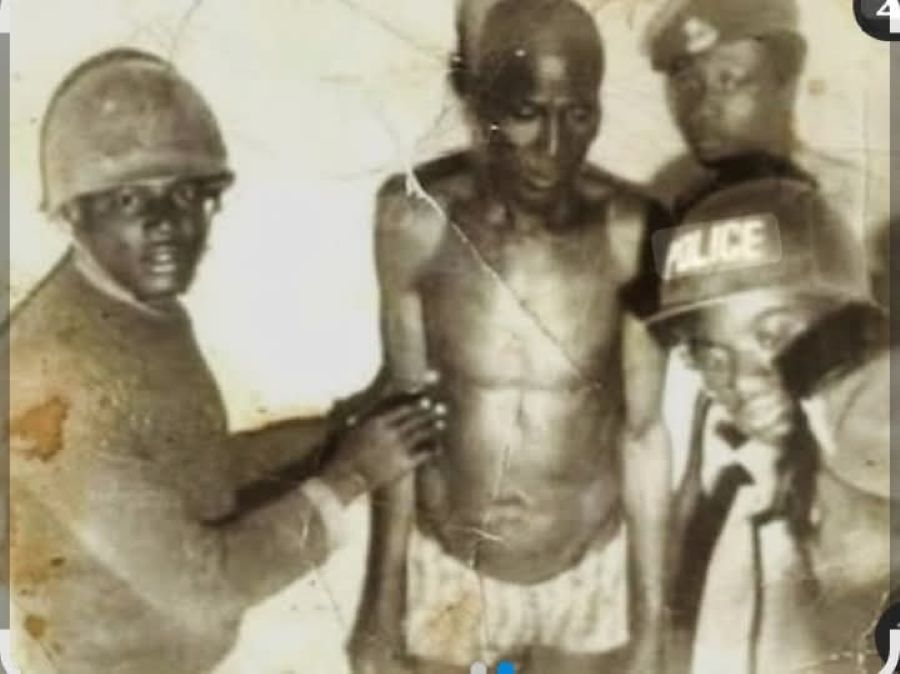
Maitatsine was the nickname of Muhammadu Marwa (c. 1920s–1980), a radical Islamic preacher whose extremist movement violently challenged Nigeria’s religious, political, and social order in the late 20th century. His activities culminated in some of the bloodiest internal religious conflicts in Nigeria’s history, particularly in Northern Nigeria between 1980 and 1985.
ORIGINS AND EARLY LIFE
Muhammadu Marwa was born into a Fulani family in Marwa (now Maroua), northern Cameroon. He later migrated to Kano, Nigeria, in the 1940s or early 1950s, a period marked by rapid urbanization, migration, and growing social inequality in Northern Nigerian cities.
Though he had some Quranic education, Marwa was not formally trained in classical Islamic scholarship. Over time, he developed deep hostility toward established Islamic authorities, traditional emirs, and orthodox Sunni institutions.
Meaning of “Maitatsine”
The name “Maitatsine” comes from the Hausa word tsine (“curse”) and means “He who curses.”
The nickname reflected his preaching style: aggressive, inflammatory, and filled with public curses directed at:
- The Nigerian state
- Traditional rulers and emirs
- Orthodox Muslim scholars (ulama)
- Western-educated elites
- Christians and secular institutions
- Ideology and Beliefs
Marwa founded a militant Quranist sect known as ’Yan Tatsine (“Followers of the One Who Curses”) during the 1970s. His ideology combined religious extremism with social rebellion: Rejection of modernity: Radios, televisions, wristwatches, bicycles, cars, and Western clothing were condemned as haram (forbidden).
Anti-Western worldview: Western education and influence were portrayed as satanic and corrupting. Anti-establishment Islam: Maitatsine rejected Hadith, traditional jurisprudence, and the authority of recognized Islamic scholars.
Apocalyptic preaching: He claimed divine inspiration and, according to some accounts, hinted at prophetic status—an act considered heretical in Islam.
Militant enforcement: Violence was justified as a religious duty against unbelievers and “corrupt” Muslims.
Recruitment and Social Base
Maitatsine’s movement thrived among:
Urban poor and migrants
Unemployed youths and school dropouts
Marginalized Almajiri children
Many parents accused the sect of abducting, indoctrinating, and brainwashing children, some as young as 11 years old, isolating them from their families and society.
THE MAITATSINE UPRISINGS (1980–1985)
Between 1980 and 1985, the ’Yan Tatsine movement launched violent uprisings across Northern Nigeria, including in:
- Kano (1980)
- Maiduguri (1982)
- Yola (1984)
- Gombe (1985)
- December 1980 Kano Riot
The most devastating episode occurred in Kano in December 1980:
- Lasted 11 days
- Over 4,000 people killed, including civilians, police, and soldiers
- Entire neighborhoods destroyed
- Heavy weapons were used by both militants and security forces
- The riot exposed Nigeria’s unpreparedness for large-scale urban insurgency and religious extremism.
DEATH OF MAITATSINE
Muhammadu Marwa was killed by Nigerian security forces during the military crackdown in Kano in December 1980. To dispel rumors that he possessed supernatural powers or had escaped death: His grave was exhumed. His corpse was publicly displayed to confirm his death
His remains were reportedly cremated and stored in a sealed jar in the Kano police laboratory. A police barracks was later built over the site of his former enclave to prevent it from becoming a pilgrimage center.
AFTERMATH AND CONTINUED VIOLENCE
Despite Maitatsine’s death, the movement did not immediately collapse. His followers regrouped and carried out further uprisings in the early to mid-1980s, forcing repeated military interventions.
HISTORICAL SIGNIFICANCE AND LEGACY
The Maitatsine movement is widely regarded as: Nigeria’s first major modern Islamist insurgency. A warning sign of how poverty, urban neglect, weak governance, and religious radicalization can combine violently. Scholars and security analysts identify Maitatsine as a precursor to later jihadist movements, particularly:
جماعة أهل السنة للدعوة والجهاد (Jama’at Ahl as-Sunnah lid-Da‘wah wa’l-Jihad)
(“Group of the People of the Sunnah for Preaching and Jihad”), commonly known as Boko Haram. Both movements share:
- Anti-Western ideology
- Rejection of secular governance
- Recruitment of marginalized youth
- Use of religious justification for mass violence
CONCLUSION
Maitatsine remains one of the most dangerous religious extremists in Nigeria’s history. His uprising marked a turning point in the relationship between religion, violence, and the state in Northern Nigeria. The Maitatsine crisis demonstrated that religious extremism rooted in social exclusion and ideological absolutism can outlive its founder, leaving a legacy that continues to shape Nigeria’s security challenges decades later.
