

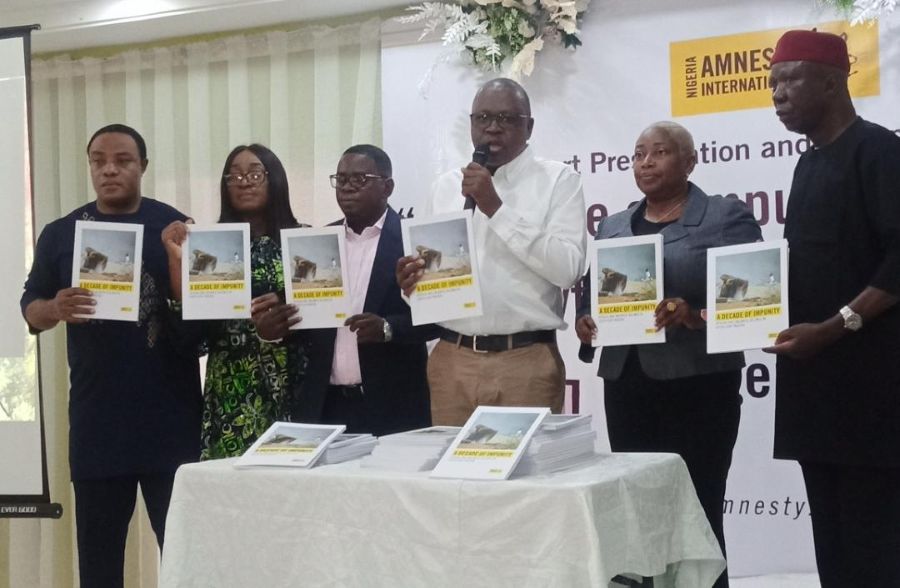
L-R: Amnesty International Director in Nigeria, Mr. Isa Sanusi (4); Prof. Felix Asogwa of ESUT (6); Maurice Chukwu of Research & Methodology, Amnesty International (3), and other dignitaries during the launch of the report …. Photo Credit: Tony Adibe
By Tony Adibe
Amnesty International has come up with a damning report, saying that the prolonged insecurity in Nigeria’s SouthEast Zone has claimed at least 1,844 people between January 2021 and June 2023, the period covered by the report.
At the public presentation of the report entitled, “A Decade of impunity: Attacks and Unlawful Killings in Southeast Nigeria,” on Tuesday in Enugu, the Director Amnesty International, Nigeria Isa Sanusi, said that the persistent failure of government to address the insecurity crisis in the zone has created a “free-for-all reign of impunity” in which numerous state and non-state actors have committed serious human rights violations and killed at least 1,844 people within the period under review.
The international human rights organization said that the Nigerian authorities must now begin addressing the security crisis in the southeast region by carrying out “transparent, impartial and effective investigation of killings, assassinations, enforced disappearances and other atrocities committed by state and non-state actors since August 2015.”
Sanusi said that the chilling report, which “documents unlawful killings, torture, enforced disappearances and arbitrary arrests at the hands of rampaging gunmen, state-backed paramilitary outfits, vigilante, criminal gangs and cults groups in the southeast” zone provides the authorities with adequate leads to open an investigation that will end the impunity and provide victims with justice.
“The Nigerian authorities’ brutal clampdown on pro-Biafra protests from August 2015 plunged the SouthEast region into an endless cycle of bloodshed, which has created a climate of fear and left many communities vulnerable. Assassinations of prominent personalities and attacks on highways,” Sanusi said.
According to Sanusi, the report, which is more like a book, is based on interviews with 100 people, including survivors, victims’ relatives, civil society members, lawyers, traditional leaders, and religious leaders. Amnesty International also conducted research missions to Owerri in Imo State, Asaba in Delta State, Obosi in Anambra State, and Enugu in Enugu State between April 2023 to November 2023, Sanusi said.
On violent attacks by “unknown gunmen”, Amnesty International said that gunmen murdered over 400 people in Imo State between January 2019 and December 2021, often emerging from their camps unmasked to carry out attacks, causing deaths and injuries for the residents.
Victims described how the gunmen appeared, routinely demanding money from Communities during burial ceremonies and weddings. Anyone who resists risks being subjected to violent attacks during the night, and their house Seton fire.
A survivor of an attack by gunmen, Ebulie, told Amnesty International: “unknown gunmen” are armed – some come with guns, cutlasses, and come for an attack, anyone who blocks their way, they will kill them. It has been a terrible situation, people are scared…”, Sanusi said.
He said that the Nigerian authorities continue to blame the pro-Biafra organization, IPOB (Indigenous People of Biafra), and its militant arm, the ESN (Eastern Security Network), for most of the deadly attacks in the region. IPOB/ESN, however, deny involvement in the activities of the “unknown gunmen” and their camps.
An activist and Executive Director of RULAAC, a Lagos-based Civil Society Organization, Mr. Ikechukwu Nwanguma, who spoke as a member of the panel, bemoaned the fact that the people of SouthEast zone “are trapped between the criminal gangs and the state security forces who unleash all manner of atrocities on the innocent people.”
Nwanguma said: “Our political leaders are not addressing the security issues in the southeast. Amnesty International has filled the gaps the leaders left in the security of the zone in terms of accountability.”
According to Nwanguma, “There’s a need for justice. Without justice, without accountability, we cannot have justice in the zone, and we can’t have security in the zone.”
In his remarks, Prof. Felix Asogwa of the Department of International Relations, Enugu State University of Science and Technology (ESUT), regretted that humanity has lost its value in Nigeria. “Life has come to mean nothing,” he said.
He, however, said that he felt very relieved after reading the “comprehensive report” as documented by Amnesty International.
Prof. Asogwa lauded Amnesty International for the “very fantastic report they have done on the southeast zone”, adding: “The detailed nature of the report is very impressive.”
NewsBits reports that Amnesty International would present the report in all five SouthEast states to drive the message home. “We intend to engage all the relevant stakeholders, including the members of Nigeria’s security forces,” Sanusi said.
He said that all the letters the human rights organization wrote to the governments in the SouthEast Zone to get their reactions to the findings they made, only Anambra State replied without anything concrete.
