

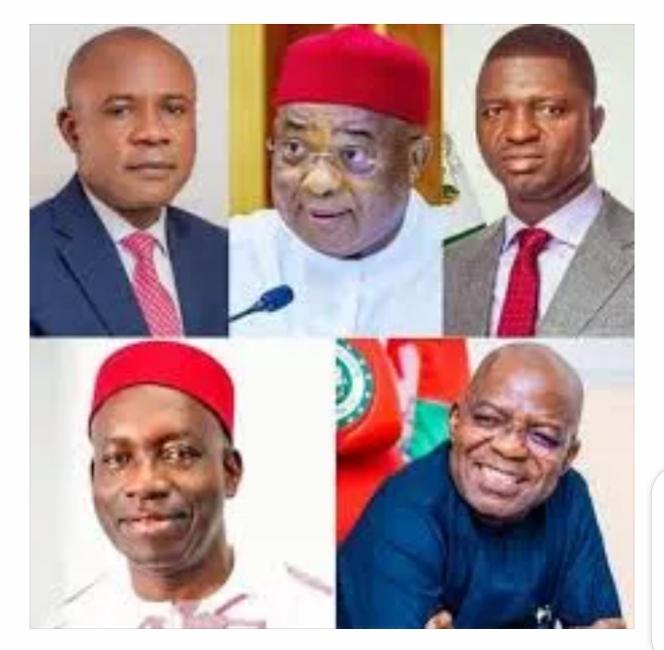
L-R: Governors Peter Mbah, Hope Uzodinma, Francis Nwifuru, Charles Soludo and Alex Oti
By Tony Adibe
Stakeholders in Nigeria’s SouthEast geo-political zone gathered in Enugu to proffer solutions to the rather prolonged security challenges in the area.
However, all the five governors in the zone – Charles Soludo (Anambra), Alex Oti (Abia), Peter Mbah (Enugu), Francis Nwifuru (Ebonyi) and Hope Uzodinma (Imo) did not take part or send representatives to the summit. And there were no reasons whatsoever given to justify their obvious absence.
NewsBits recalls that this is perhaps not the first time the southeast governors would display what observers regarded as “indifferent attitude” to talks on security matters in the region.
At the recent public presentation of a 124-page report by Amnesty International entitled, “A DECADE OF IMPUNITY: Attacks & Unlawful Killings in SouthEast Nigeria,” held in Enugu, the Amnesty International had accused the five governors of not replying to its letters in which it sought their reactions to the findings on alleged gross human rights violations committed by state actors and non-state actors in the zone.
“All our official letters to the five governors requesting for a meeting with Amnesty International delegates in relation to the violence in the southeast zone were never replied. It was only Anambra State where an aide to the governor promised to reach out to us, but up till now no communication from them again,” Isa Sanusi, Director, Amnesty International Nigeria told the huge gathering in Enugu. “It goes to show the attitude of the leadership,” he added.
But the summit convened on Thursday by the Nigerian Senate’s National Security Summit, had the objective of harvesting practical inputs toward ending the persistent security crisis in the region, NewsBits learnt.
Despite the governors’ absence, however, the event attracted lawmakers, traditional rulers, Ohanaeze Ndigbo, military and paramilitary agencies, local government chairmen, town union President Generals, religious organisations, youth groups, farmers, traders and vigilante operatives.
Declaring the summit open, Coordinator of the SouthEast event, Senator Austin Akobundu, said the Senate convened the national dialogue to gather firsthand perspectives from citizens and leaders in regions most affected by insecurity.
He warned that the Southeast’s worsening security environment, marked by killings, destruction, economic stagnation, school disruptions and declining communal life, requires urgent, sincere action.
According to Akobundu, “The whole communities are traumatized and displaced, farmlands abandoned, schools disrupted, with grave socioeconomic consequences including spikes in poverty, hunger and illiteracy.”
He condemned violent agitations in the region, insisting that “violence solves nothing and can never be a pathway to self-determination,” although he also acknowledged, quickly, that issues such as “inequity, marginalisation, unemployment and poverty must be addressed headlong to stem the crisis.”
Akobundu said that the actions of these non-state actors have left the southeast region bleeding as lives are lost, properties are destroyed, people are displaced, schools are no enrolment and even performance in national and international exams where the southeast region had hitherto established itself as an unchallengeable colossus of academic excellence.
According to him, “It is on this note that agitators in the southeast must be made to understand in no uncertain terms that violence solves nothing and can never be a pathway to self-determination. It can only worsen an already bad situation. We are stronger together.
“The declaration of Mondays as sit-at-home and the deployment of violence as a strategy by some sections of these agitators have adversely affected the region’s economy and its attendant consequences on our people. Unfortunately, not even revered institutions like places of worship, traditional entities, etc, are spared by the mayhem. The situation is quite worrisome!
“We cannot gloss over the fact that an average Igbo man is very enterprising and republican. Our people are not used to begging for bread or depend on others for their livelihoods. We must, therefore, do everything within our powers to restore normalcy to our highly cherished region and create the enabling environment for our people to thrive.
“We must return to the days when the elders instilled in our youths the virtues of honesty, hardwork, and respect for humanity that made the Igbo nation an irresistible partner in progress and a force to be reckoned with in life’s enviable endeavors. We can no longer afford to live on the glory of yesteryears when there are higher ground and greater opportunities to take advantage of.”
Senator Akobundu appreciated the efforts of the Governors who have shown “uncommon grit, determination”, and deployed innovative strategies in their individual and collective efforts to quell extremism and restore law and order in the region.
He said: “They make a good example of what we can all achieve together if we do not give in to rascality and if we confront criminality headlong. I bring a message of appreciation and goodwill from the senate to our dear governors. The Senate stands with you in this mission.”
He told the stakeholders that the Senate “is primed today more than ever before to rely on inputs from the summit” to amend and, where necessary, repeal existing laws, and make new comprehensive ones to ensure a more secure and prosperous Nigeria.
He assured that the National Assembly “will continue to play its role” in ensuring that inter-agency collaboration among “our security agencies is sustained” and that adequate resources required for the actualization of “this all-important task” of restoring the southeast to the path of peace, progress and prosperity, are not only appropriated but also released as and when due.
Enugu State represented by the Speaker of the House of Assembly, Uche Ugwu charged security agencies to invest heavily on intelligence gathering. He emphasised the need for “all hands to be on deck” to tackle the menace of insecurity in the Southeast and Nigeria at large.
Ugwu described the summit as an opportunity for the Southeast to “listen, understand and suggest solutions in line with the realities on ground.”
He restated that security must be rooted in intelligence gathering and socioeconomic stability. He said: “We must invest in intelligence gathering while not neglecting the economic conditions that make our people, especially our young ones, vulnerable to criminal activities.”
Ugwu emphasised the need to rebuild trust between communities, government and security agencies. “When communities trust their security agencies and when leaders speak with one voice, insecurity loses its strength,” he said.
The Speaker also identified farmers-herders clashes and open grazing as major drivers of conflict in the Southeast, warning, however, that “anything open grazing in the Southeast is against the peace of the land.” He called for urgent consideration of state police, arguing that decentralised policing would help create safer communities.
“Security cannot be achieved by force alone,” he said, adding: “The issue of state police is something we should look into to create an enabling environment in our communities.”
