

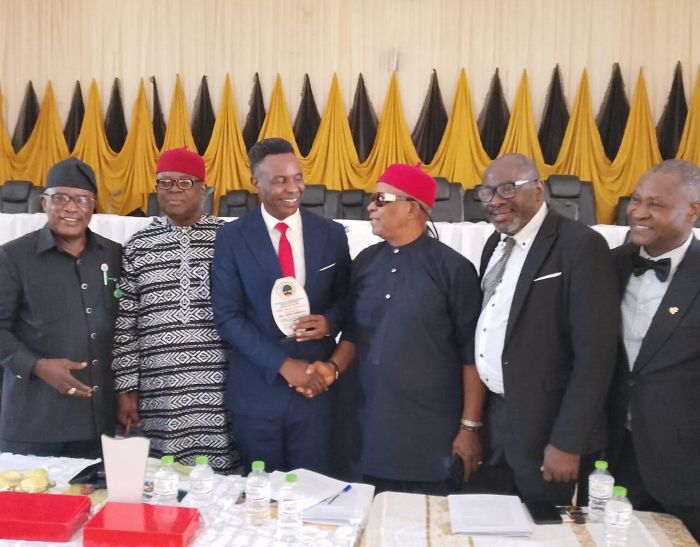
L-R: Dr. Uchenna Cyril Anioke (2), Dr. Ben Nwoye (3), in a handshake with one of the dignitaries, while other guests look on with admiration
By Tony Adibe
The various political parties operating in Nigeria have been urged to always use mediation and conciliation as a means of resolving internal friction rather than rushing to court.
The Deputy National Chairman (South) of the All Progressives Congress (APC), Dr. Ben Nwoye, who gave the advice, insisted that proper conflict management would “reduce political violence and election-related litigation across the country.”
Nwoye emphasised that effective mediation would also prevent politicians, however desperate, from swiftly approaching the courts for, apparently, not very serious internal party disputes.
Dr Nwoye spoke on Wednesday at the Annual Lecture of the Enugu Branch of the Institute of Chartered Mediators and Conciliators (ICMC). He said many political crises stem from the absence of trained party managers capable of resolving disagreements before they escalate.
The politician also appealed to the ICMC to partner with both the ruling and opposition parties to build the capacity of political leaders in alternative dispute resolution. According to him, political office holders often emerge at the ward, local government, state, and national levels without receiving any formal training in conflict resolution.
He said: “If we train these local actors, those at the ward level, local government level, and state level, you will see that the incidence of political hostility will reduce. People will know how to engage and deal with political crises and manage them without resorting to violence.”
“These are simple internal dispute management issues. If they had the basic training and understanding of the importance of mediation and conciliation within the party system, this whole notion of going to court would reduce, if not disappear, because most of those matters are supposed to be resolved internally,” he said.
He referenced disputes over candidate nominations in some political parties as examples of conflicts that could have been resolved through dialogue rather than prolonged litigation. He further explained that the peaceful conduct of the APC primaries in Enugu State, to deliberate peace-building efforts undertaken before the exercises, was a result of this measure.
“We did primaries in Enugu State, and they were seamless. We didn’t have a lot of discrepancies or infighting. Some form of mediation occurred before the primaries. People gave up some of their rights when they understood it was in the overall interest of society,” according to the APC Chieftain.
Focusing on the outcome of the process, the politician said the party recorded only one court case from its House of Representatives primaries, while there were no legal disputes arising from its local government, House of Assembly, Senate, and governorship primaries. Nwoye, who received an Award of Excellence from the institute, described the recognition as particularly meaningful.
“Usually, politicians are not seen as peace builders. People say politicians are troublemakers, but the little things we do to stabilise society are not always visible. If you recognise me for that, I am most grateful,” he said.
Earlier, the national President of the Institute of Chartered Mediators and Conciliators, Godwin Omoaka (SAN), said Nigeria must move beyond voting to institutionalising mediation as an essential component of the electoral process.
Explaining the lecture theme, “Beyond the Ballot: Institutionalising Peace, Legal and Policy Framework for Electoral Mediation,” as timely, Omoaka, represented by Dr. Uchenna Cyril Anioke, said democracy should not end on election day but should include mechanisms for peacefully managing post-election tensions.
Omoaka said: “Violence is not inevitable. Disagreement can be mediated.” He, however, stressed that the institute had over 5,000 certified mediators nationwide and was ready to partner with INEC, political parties, the judiciary, and governments to embed electoral mediation into governance and electoral policy frameworks.”
He equally lauded the Enugu State Ministry of Justice for its reform initiatives and expressed confidence that stronger collaboration among stakeholders would promote peaceful elections and democratic stability in Nigeria.
