

By Tony Adibe
There is the notion in certain circles that Biafra is, literally speaking, the ‘opium’ of most south easterners. This seemed proven when, after about 59 years, some survivors of the Nigerian/Biafran War (1967 -1970) recounted nostalgically their ordeal at the public presentation of a new book, “History and Lessons From The Nigerian Civil War (Chronologically Arranged), in Enugu, urging that such painful experience should never repeat in the country, whatever the provocation.
“History and Lessons From The Nigerian Civil War (Chronologically Arranged) was written by three authors – Dr Uchenna Anioke, Chief Obioma Ikechi and Chief James Egwuonwu. The authors said that they wanted the book to inspire young generations to embrace peace and conversations on national issues instead of resorting to anarchy or conflict.
The development comes just as the Governor of Enugu State Dr Peter Mbah, on the occasion made a strong case for the quick return of history as a subject in Nigerian primary and post-primary schools.
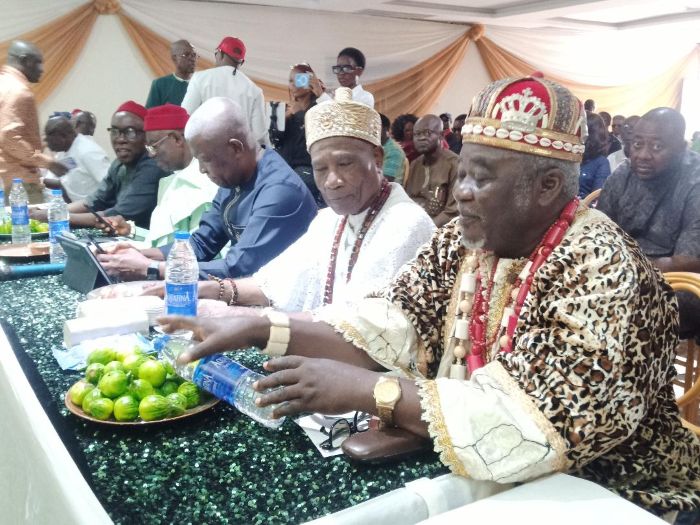
NewsBits reports that the book launch/presentation attracted academics, traditional rulers, public officials, historians, journalists, scholars, students and other stakeholders. Recounting his ordeal during the war, a survivor who is the Enugu State Commissioner for Environment, Prof. Sam Ugwu remembered how his elder brother, Cletus, a teenager, was residing in Zaria, Kaduna State, with his master, an indigene of Olokoro, Umuahia, Abia State, during the conflict.
Prof. Ugwu bemoaned what he regarded as the poor attitudes of Nigerians to the lessons from the tragic crises of that era. “We in Nigeria don’t appear to have learnt any lesson from what happened during the civil war. I was in primary one when the civil war started,” he said. “I went through all the bushes with my parents, hiding, running away from the activities of the Nigerian Military Government under General Yakubu Gowon. Eventually, we survived,” he said with nostalgia.
A Professor’s More Painful War Experience:
He said that at the onset of the war, the master to his elder brother, Cletus took him from Zaria straight to Olokoro, Umuahia. But somehow, Cletus insisted on joining the Biafran Army following the taunting from his master’s wife. The woman had mocked Cletus, saying that he was only eating food like a glutton at home while his mates were in the battlefield fighting the enemy. He said that the mockery became too much for the teenage Cletus to bear, prompting him to approach his master to pray for him, as he wanted to join the army. Cletus’ master objected because he was still a teenager. “The master would hide Cletus and his own son, who was doing first year in secondary school, inside the sealing to avoid conscription into the Biafran Army,” Prof. Ugwu recalled.
Somehow, Cletus’ worry to his master became too much, and he prayed for him before he enlisted in the Biafran Army and underwent two-week training. “This was the story my brother told us. He said he had a friend called Kenneth, from Igboeze in Enugu Ezike. The first day they went to the war, his friend Kenneth was killed. My brother survived till 1970. He was at Olokoro when the war ended. And he said that immediately they heard that the war had ended, they threw away their guns.”
Nigerian Soldiers Arrested My Brother & Six Others
Prof. Ugwu recalled how in 1970, they were in the Legion of Mary Church programme when they heard that Cletus had returned. “Cletus said they trekked all the way from Imo State, through Abia, and got to Enugu, where they met the Nigerian soldiers. They were about seven in number. They met other soldiers coming home.
“And they were arrested by the Nigerian soldiers. They just arrested them and told them to sit on the ground. The Nigerian soldiers gave them food to eat, but they refused. They thought the Nigerian soldiers were going to poison them. But the Nigerian soldiers persuaded them to eat and be happy.
“So, after eating, the Nigerian soldiers brought a lorry and asked them to enter the lorry. They brought them to Abakpa Junction, Enugu, and took the other Biafran soldiers to Abakaliki; those who were returning to Abakaliki. He said the Nigerian soldiers told them that look how they (soldiers) are suffering here while Emeka Ojukwu and Yakubu Gowon are at home enjoying themselves with women in their comfortable rooms. He said that that was the last statement from the Nigerian soldiers who assisted them.”
My Auntie’s Only Son Went To War But Never Returned
Prof. Ugwu further explained the reason for recalling the plight of people during the war, insisting that Nigeria, and indeed, Igbo youths should not resort to anarchy no matter the provocation. “My own auntie had a son who made distinction in primary school examination. He went to the war, and he was the only son of the father then. And the mother died five years ago, my auntie. Every day the woman would cry because of the boy who had distinction and went to war but never returned.
“Why I am recalling all these stories is because of our young ones who are shouting war, war, war all the time. War is the worst thing that will happen to any society. We can use dialogue. If we, the people at that point in time, had used deep dialogue, things would have been better. The war was avoidable. I want to commend Dr Cyril Anioke and his co-authors for bringing out this book. It’s a very important book. Everybody must try and read,” said Prof. Ugwu, who represented Governor Peter Mbah, although he insisted that his recollections on the civil war were not Governor Mbah’s remarks.
But speaking specifically on behalf of Governor Mbah, Prof. Ugwu said the Governor advocated for the quick restoration of history as a subject to be taught and learned at Nigerian primary and secondary schools. He said Governor Mbah described history as essential for understanding the past and shaping the future.
Ugwu said that, according to the Governor, the new book was an important documentation of the remote and immediate causes of the civil war, adding that the work also spotlighted the socio-economic and political implications of the war at the time.
He said Mbah insisted that the removal of history as a subject from the school curriculum was dangerous to learning and advised the curriculum planners to ensure proper teaching and learning of Nigerian history. Ugwu said Governor Mbah lauded the authors for documenting the conflict in chronological order and urged Nigerians to read the book and learn from its lessons.
Chairman of the occasion, and Managing Director of COPEN Group, Pastor Ugochukwu Chime, remembered his personal ordeal during the civil war, recalling how he miraculously survived a bombing incident when he was carried and thrown into a ravine. According to him, several members of their family were consumed in the war, and he urged the authorities to ensure the country doesn’t experience such tragedy again. “It’s not an experience one should have twice in a lifetime because it’s terrifying,” he said.
Chime appreciated the authors for their collaboration and choice of focus, an angle not many writers have explored. He said the collaboration among the authors would bring about development in Nigeria and Igboland. He said that the book presentation ought to go beyond the ceremony, and advised Nigerians to read the book and learn lessons from it, stressing that a sense of history was essential for informed decisions about the present and future.
Nnamdi Kanu’s Activities Gave Igbo Impetus To Discuss Biafra, Says Dr Onu
In his speech, the President of Dr Michael Okpara Leadership Centre, Dr. Chinedu Onu, who represented Ambassador Ifeanyi Ugwuanyi, said the authors’ objectives and goals were in tandem with the teachings of the Michael Okpara Leadership Centre. “The authors of the book and almost all the speakers here today are saying ‘ozo emene’ (never again!). But we shouldn’t forget that there was an action that brought about a reaction,” Onu said. “Let me repeat it: Hate or like Nnamdi Kanu (detained leader of IPOB), his activities have given us the currency to begin to talk about Biafra. In the past, to discuss the Nigerian-Biafran war was impossible, but today you can discuss it even in the National Assembly of Nigeria,” he said.
Onu regretted that the war scuttled the developmental agenda which Dr M.I. Okpara was implementing in the old eastern region. “Those of us at the Michael Okpara Leadership Centre, we believe that it was that war that truncated what Dr. Michael Okpara was doing in the old eastern region. Recall that a study at Harvard University adjudged the economy of Eastern Nigeria under Dr Michael Okpara’s administration as the fastest-growing economy in the whole world; faster than China or all the Asian tigers. So, if the war did not happen at that time, where do you think the Igbo would have been today?
“The Igbo say that ‘nchetaka’ (to remember is greater). If we don’t remember it, our children will still make the same mistake their parents made in the past. So, we have to remember and tell our children about our history. And that is why any time there is an issue in the North or Abuja or Lagos, and they say the Igbo should come and join in protest; the Igbo will have to be careful because once they participate, the whole thing would be used against the Igbo. They would be used as scapegoats.”
Dr Onu criticized the attitude of the southeast governors when matters of the purported Igbo maltreatment are discussed. “The governments of southeastern Nigeria who continue to say that the way Nnamdi Kanu is going is not the right way to go, but they failed woefully to present an alternative. You can’t beat a child and ask that child not to cry,” he stressed.
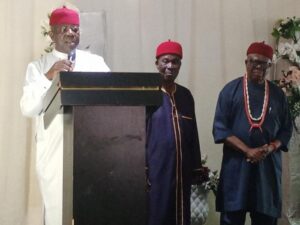
Earlier, the lead author, Dr Uche Anioke, who spoke on behalf of the others, said that the book provided an objective and chronological account of the Nigerian Civil War. According to him, the publication was written to highlight lessons from the 1967 to 1970 war for present and future generations.
Anioke explained that the history of the war had often been told in fragments, shrouded in silence or viewed through biased perspectives, adding that such presentations had left younger Nigerians without a clear understanding of the events that led to the conflict.
He said: “Today, we are not just presenting a book; we are unveiling a mirror for our nation. When three of us — Ikechi, Uchenna and Egwuonwu — sat down to begin this project, we asked ourselves a critical question.
“How do we tell a painful history objectively so that it heals rather than divides? Our answer was structure and chronological accuracy. By arranging these historic events strictly by date, from the early rumblings of 1966 to the final declarations of 1970, we avoided political distortion.”
He said that the book provided a factual, step-by-step account of the crisis and its underlying developments, emphasizing that Nigeria could not build a stable future on a foundation of forgotten or distorted history. He said the primary goal of the book is to foster national unity, promote institutional memory and encourage reflection on Nigeria’s past.
Anioke said the book was intended for students, policymakers and Nigerians interested in peace and national development. He said: “The lessons of the Civil War teach us that peace is a deliberate choice. We hope this book inspires you to choose dialogue, empathy and unity every day. Our book is not a weapon meant to reopen old wounds of the Civil War. Rather, it is meant to be a mirror to reflect our shared responsibility and historical heritage.”
Book Reviewer Speaks
The book reviewer and Chairman, Public Affairs Analysts of Nigeria, Enugu State chapter, Dr Ambrose Igboke, said the publication was particularly important for younger Nigerians who did not experience the war. Igbokwe said he had read several books on the Nigerian Civil War but found the chronological arrangement of the new publication particularly useful.
According to him, the authors traced Nigeria’s historical development from the colonial period through independence, political crises and coups. The book also examined events that eventually culminated in the Civil War, according to Igboke, who was quick to warn against romanticizing war, particularly among youths who might perceive it through films and social media. Igbokwe stressed that the consequences of war were devastating and could not be compared with its portrayal in entertainment or online videos.
