

By Tony Adibe
The Independent National Electoral Commission (INEC) has said that accurate election reporting is not a favour to the commission, but a service to the public meant to strengthen the electoral process.
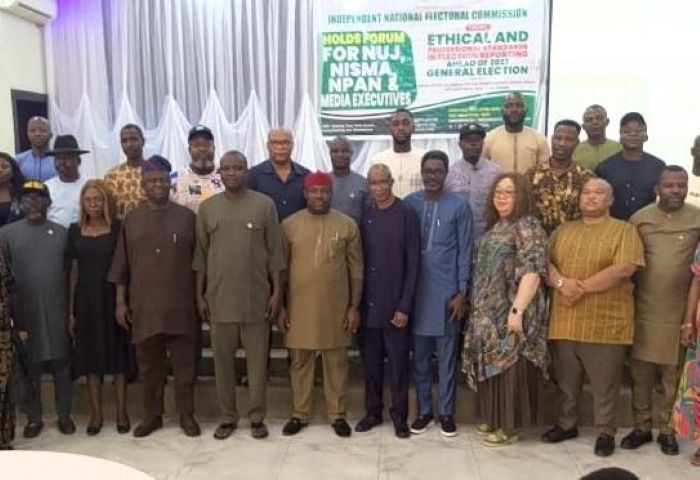
The National Commissioner and Chairman, Information and Voter Education Committee (IVEC), Mallam Mohammed Haruna, said this at an INEC Forum for members of the Nigeria Union of Journalists (NUJ) and Media Executives held in Enugu on Monday.
The development comes as the Comrade Obinna Ogbuka-led NUJ Enugu State Council requested the electoral commission to assist the union with logistics to facilitate the movement of journalists before, during, and after coverage of the polls.
Ogbuka pleaded with INEC to provide logistics and working tools for journalists, just as the commission made provision for other critical stakeholders of the electoral process. “The media should be fully factored in terms of funding to enable journalists to carry out their noble duties before, during, and after the elections, effectively, “ said Ogbuka, who called for continuous engagement of journalists by INEC.
NewsBits reports that the forum was themed: “Ethical and Professional Standards in Election Reporting Ahead of 2027 General Election”.
Addressing the forum, Haruna, who was represented by INEC Resident Electoral Commissioner (REC) in Enugu State, Dr Chukwuemeka Chukwu, said that journalists must verify information, especially controversial ones, before publishing.
“It means journalists must separate news from political advertising, avoid hate speech and inflammatory language, give fair space to all candidates and parties, and correct errors promptly and prominently. These standards are already enshrined in your own Code of Ethics. Our task today is to consider how best to live them out in the 2027 election cycle.
“Election-day reporting carries particular risks. A polling unit result is not the outcome, and a single incident is not the story of an entire election. Premature or sensational reports can inflame tension, discourage voters from coming out and, in the worst cases, put lives at risk,” he said.
Haruna also stressed against a phrase trending in the political space, which is “rig and die,” adding that a slogan that links “an electoral offence to death is dangerous.” He further said that at the polling unit, the people most exposed are not powerful politicians.
He said: “But ordinary Nigerians serving as presiding officers, assistant presiding officers, collation officers and other ad hoc staff, alongside voters, party agents and observers. A charged crowd can easily mistake a delayed result, a technical hitch or a rumour for rigging, and a mistake of that kind can never be undone.
“Rigging is a crime, and the Electoral Act 2026 prescribes penalties for it. The remedy lies in the law: vigilant observation, transparent results on IReV, formal complaints to the Commission and the security agencies and, where necessary, the courts.”
The right to life is guaranteed by Section 33 of the Constitution, and no one may take it on suspicion, according to him. On Enugu State, the INEC REC in Enugu State, Dr Chukwuemeka Chukwu, explained that activities of INEC had been ongoing smoothly and the commission had continued to engage critical stakeholders in the build-up to the election.
He also spoke on the complaints of some not getting to collect their Permanent Voter Cards (PVCs). He said that the sharing of cards for registrants of the second and third quarters of the Continuous Voter Registration (CVR) would commence from November 15. According to him, “For the first quarter, over 35,000 cards have been distributed. Everybody seeking to collect their PVCs must surely collect them before the election, and our offices are open.”
