

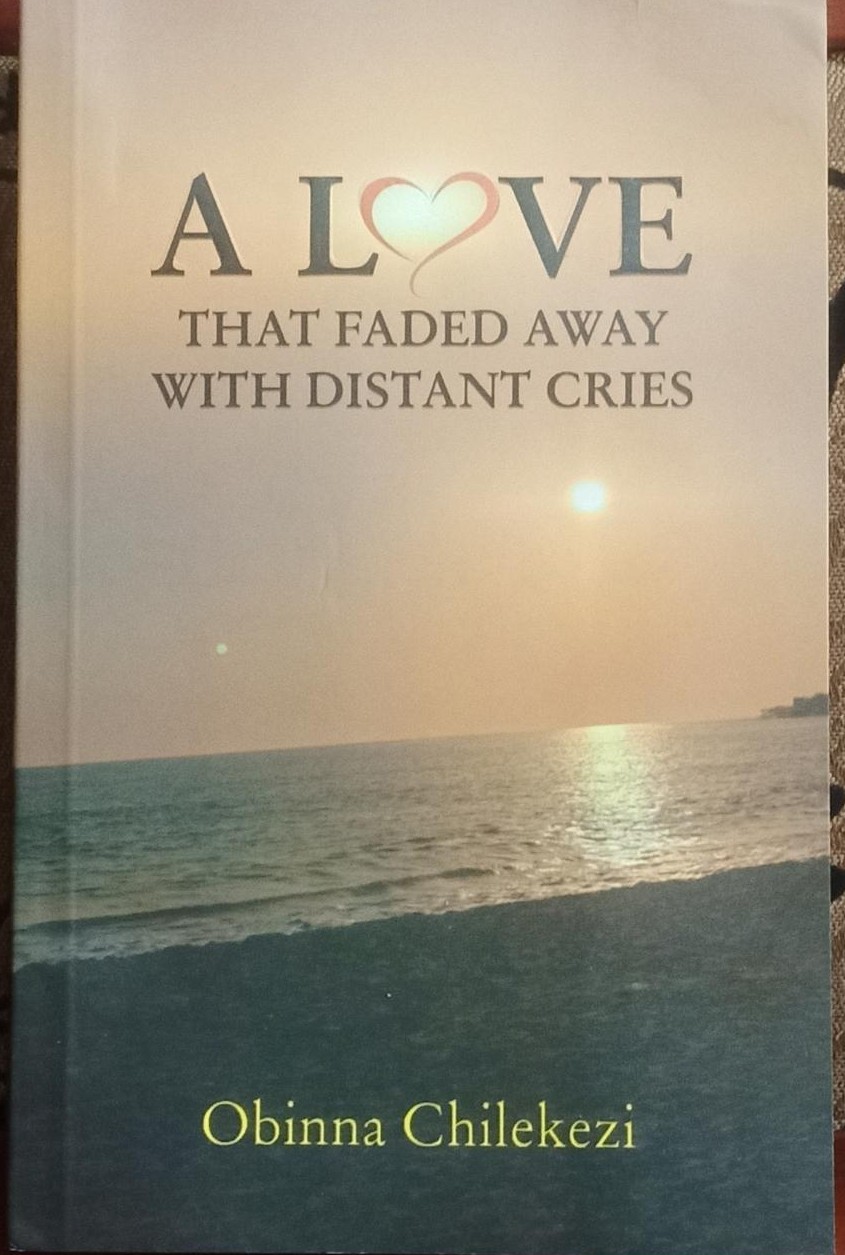
The Book Cover
By Tony Adibe
Continental insurance guru, author of many books, poet, researcher, and librarian extraordinaire, the proud Mbaise, Imo State-born scholar, Dr Obinna Chilekezi, is not a greenhorn when it comes to writing books. He has written and published several collections of beautiful poems before this latest one, “A Love That Faded Away With Distant Cries,” a collection of about 60 poems, many of them focusing on love. The slim book was published in 2026 by Kraft Books Limited, Ibadan, the capital of Oyo State, in Nigeria’s South-West Zone.
“A Love That Faded Away With Distant Cries” is a story of love turned ash but told in fascinating poetry. We read about a jilted lover bemoaning the rather disrespectful and “I-don’t-care’’ manner in which he was dumped by a ‘flying pigeon’ who had a ‘Plan B’ that she never revealed to the man she called “Mine”, “Mine” now and then as they dated for eight consecutive years. One may say that’s the way of some women! Initially, I titled this review “The Lamentation of The Jilted Lover”. But upon realizing that the root cause of Soxna parting ways with the poet was nothing but this ‘poison’, ‘monster’, ‘opium’ called religion, I changed it to “This Monster Called Religion”!
Beyond the theme of conflict in religion, frustration, betrayal, ‘used’ and ‘dumped’ lover, there is also the theme of appearance versus reality, the ‘japa’ syndrome, and retributive justice. The way one perceives the Whiteman’s land as a place of greener pastures, where milk and honey flow daily, may not be the truth after all! Soxna didn’t find life easy with her ‘‘black British Muslim guy’’ in the “Wintry Country,” where she was sexually exploited until she was impregnated against her will, and unfortunately suffered a terrible miscarriage that landed her in the hospital, quite devastated emotionally.
Not only was Soxna used as a sex slave, but she also worked, not really as a housewife, but more like a house girl with no sense of ‘equal rights’ in the matrimonial home; she finds herself as a typical ‘Muslim housewife’, like her auntie would urge her to always behave. She was filled with regret and rage because here in Africa, she was a Princess and had maids surrounding her, and the poet-lover she abandoned had always treated her like a queen. Soxna suffered unemployment and poverty overseas, even when the family she left behind in Africa, unaware of her predicament in the hands of her ‘black British Muslim guy’, expected her to send money and other good things home like her other mates living abroad.
The Igbo have a wise saying that ‘Nwanyi luo di abuo, ya malu nke ka nma’ (When a woman marries twice, she would appreciate the better husband!) Soxna , no doubt, later realized and appreciated that the poet was a better husband who gave her the true love she badly needed, but that she squandered the opportunity due to religious and parental factors or influence.
Now she was full of remorse. In the poem, “The Search For Job”, Soxna lamented her ordeal in the Wintry country thus: “The bus fare was five pounds per day, I can’t afford this. I know what it was back home…Back home I was a manager. Today a cleaner of toilets and other people’s mess for a living. I wash plates and do odd jobs to eat.” Life is not balanced, and no condition is permanent. Had Soxna known that life would have turned her world upside down in the Wintry Country, she would have forgotten her “mother and father”, as Juliet would urge Romeo in Shakespeare’s “Romeo & Juliet”, and gone ahead to marry the poet!
Not every writer would be able to achieve this kind of literary feat. That is, using poetry to narrate a story without allowing it to lose its setting, plot, theme, climax, anti-climax, and other elements. Many readers in the Nigerian environment are probably used to consuming romance written in prose.
Chilekezi’s latest offering appears similar to “Our Sister Killjoy,” written by Ama Ata Aidoo, a prominent Ghanaian author and poet; the semi-biographical book that blends prose and poetry to track a young Ghanaian woman named Sissie travelling through Europe. Also, “A Love That Faded Away With Distant Cries,” to a large extent, is similar to “So Long A Letter”, penned by the famous Senegalese writer, Miriama Ba, where the author seemed to have explored the pain of husbands taking second wives or even more in building relationships. Miriama Ba’s ‘So Long A Letter’ is indeed written as a long letter from Ramatoulaye to her friend Aissatou. The marked difference between Chilekezi’s book and the two literary works referenced above is that while his is entirely poetry, the other two books are a blend of prose and poetry. No doubt Chilekezi’s latest contribution would help to enrich African literature, however.
Genesis:
Recalling the history of their romance that suddenly began in a classroom, in the poem, “That Fateful Day,” the poet wrote: “I walked into the class, taught them the lesson for the day, and on my way out, she walked to me with a gift. What’s it, I asked. It’s coconut. You will enjoy it, she said. I took it from her. Please get me dinner when you come for evening class, she added. I saw her beautiful eyes so full of innocence. I bought her the dinner. Presented same to her in the presence of her mates. She smiled, and I lost my resistance to saying no to Gambian girls. She thanked me and called me her husband. I walked away more embarrassed to the class. This was the beginning of this journey of love and sadness. When she left, after years of loving, I cried, wishing I never let her into my heart chambers.” (P.22). That was how the romance began, according to the poet.
Thematically, the book is also about two lovebirds – the speaker, poet, and a ‘lovebird trapped’ in his ‘love net’ in far away The Gambia, a West African Muslim country. He was invited to teach in a tertiary institution in The Gambia. And it’s as if the ‘magic’ or ‘miracle’ of the poet’s intellectual power captured the Gambian girl, Soxna, who eventually fell head-over-heels in love with the poet-lecturer.
Describing the level of intimacy the poet shared with his damsel, in the poem tagged, “How?”, he wrote: “You came. Brought foodstuff. You shed all your clothes, except, your pants and bra. Off to the kitchen. While there I sat, watching and admiring such a gift the smiling coast had slapped on my lap. You cooked. We ate. Talked till nightfall, before you left for home. This was our ritual for eight farm harvests. So how could I have doubted you, or suspected this new you, my Soxna. Tell me, how do you doubt a woman /Who called you mine morning till night/How?” (p.24).
This seems to be the crux of the matter. The poet enjoyed tr?” (and intimacy with the Gambian woman, not knowing her heart was miles and miles away from him. Then under the 7-line poem tagged, “Wishes’’, Soxna tweeted: “How I wish you were a Moslem, Or how I wish I’m a Christian’, You tweeted. Silence. Silence. Silence.’ Here the reader is reminded of “Telephone Conversation’’, a poem by Professor Wole Soyinka that captured his conversation on the telephone with a prospective landlady in England during his days as a student anxious to get accommodation. However, Soyinka was snubbed by the landlady because of the deep-rooted racial segregation problem at the time. The landlady was white, while Soyinka is a black man.
In Chilekezi’s recollections, the female student was a Gambian while the lecturer was a Nigerian. For eight consecutive years, the poet literally ‘lived’ with Soxna as ‘husband’ and ‘wife ’, but the process of formalizing the ‘matrimony’ was, however, irrevocably scuttled by the evil poison or monster called religion. The poet was a Christian while Soxna was a Muslim. Tribe or nationality was not the real issue now, but the major challenge was conflict of religion.
The poet’s family (Christians) accepted Soxna, but her family (Muslims) rejected the poet because he refused to convert to Islam to qualify to ask for their daughter’s hand in marriage. He is an ‘infidel’, and therefore unfit to ‘marry our daughter’, Soxna’s parents might have reasoned. But the poet was not seen as an infidel if, and when he was busy ‘eating’ or ‘leaking’ the ‘honey’ for eight years! As soon as he talked of marriage, he was branded an infidel. That sounds like hypocrites! Doesn’t it?
The author has used poetry to narrate a story about the ‘human bird’ Soxna, in his warm embrace for eight unbroken, romantic years; that ‘flying pigeon’ eventually escaped when he least expected it and landed on another guy’s lap, her “black British Muslim guy” in far away Wintry Country, United Kingdom. This ‘bird’ is not likely to come back to the poet. And I don’t see this ‘prediction’ failing! Soxna entered the poet’s life suddenly and parted suddenly. One other good lesson in Chilekezi’s poetry is that life is not as real and objective as we sometimes think.
The African youths rushing to the ‘Oyibo’ (White) man’s ‘Wintry country’ must think twice before taking a ‘dive’. What they are told may be quite different from what exists when they reach there. And once you enter, you don enter be that! It’s like boarding a ‘one-chance vehicle’, as we say in Nigeria. When you board such a vehicle, there may be no second chance for you to make a U-turn! It could be risky. It could be dangerous, and you could be killed in the process! The key lesson here is that the ‘greener pasture’ African youths are told about that exists in the ‘Wintry country’ (Europe) may be an illusion, a mirage when they get there, ironically speaking!
