

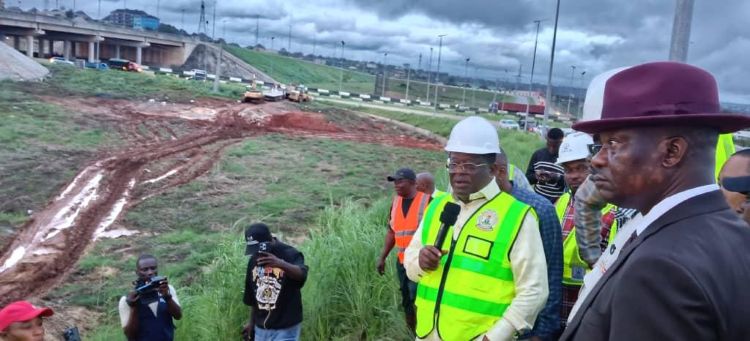
Nigeria’s Minister of Works, Engr. David Umahi, has ordered the immediate arrest of the Managing Director of Hartland Nigeria Ltd for the company’s alleged failure to execute an 11-kilometre section of the Benin–Onitsha Expressway in spite of being paid approximately N14 billion for the contract.
Engr. Umahi gave the order on Thursday during an inspection tour of federal road and bridge projects along the Agbor–Asaba–Onitsha Road where he expressed deep displeasure for 0the contractor’s alleged breach of contractual obligations. The minister revealed that Hartland had executed only about 40 per cent of the contracted project—stretching from Summit Junction to the Head Bridge—which included channelisation works and the construction of hydraulic structures.
“I’ve called the MD to discuss their return to the site. I am going to look for him and have him arrested,” Umahi declared, instructing ministry officials to immediately track down the company’s chief executive. He further directed the ministry to initiate legal and administrative measures to recover the funds paid to the firm, while ordering an immediate audit of Hartland’s payment records and valuation certificates across all its ongoing federal assignments.
“When I paid them that money, we reached an agreement: they were to finish 11 kilometres from Summit Junction to this Head Bridge with that money, as well as handle the channelisation and hydraulic structures. That was the agreement,” he emphasized. Today, they have only completed about 40 per cent of what was agreed upon,” the minister added.
Umahi subsequently ordered the immediate earth-filling of both approaches to the Head Bridge, mandating ministry engineers to ensure that remediation works commence without delay. The minister’s directive formed part of a broader inspection that evaluated the physical condition and operational security of both the First and Second Niger Bridges—two critical transport arteries linking Southeast Nigeria to the rest of the country.
At the First Niger Bridge, Engr. Umahi expressed grave concern over widespread vandalism involving the theft of structural bolts, expansion joints, and critical steel components, warning that the continuous damage poses a serious threat to the bridge’s structural integrity.
To mitigate further risks, he ordered the prompt replacement of the vandalised fittings and instructed engineers to begin welding structural repairs immediately.
As part of enhanced security protocols, the Federal Government plans to deploy closed-circuit television (CCTV) systems and solar-powered street lighting along the entire span of the bridge.
Umahi stated that real-time CCTV feeds would be routed directly to designated ministry officers and police command centers to ensure the swift apprehension of vandals.
“We will fix solar streetlights and CCTV on this bridge, and that will be transmitted to your phone and also linked to the police,” he said.
He also announced upcoming routine maintenance and asphalt resurfacing along the route, noting that the operations would take place at night and require brief, scheduled closures of the bridge.
Reassuring the public regarding occasional structural movements or vibrations on the First Niger Bridge, Umahi clarified that minor oscillations are standard engineering behaviour in major bridges and do not indicate impending structural failure.
At the Second Niger Bridge, the minister assessed areas threatened by erosion and directed immediate engineering interventions to halt further soil degradation. He also mandated security agencies to arrest individuals engaged in illegal sand excavation around the bridge’s piers, warning that unregulated dredging threatens the foundation of the critical infrastructure.
Umahi maintained that the government would no longer tolerate the continuous destruction of public assets by vandals and illegal operators while public funds are actively being committed to infrastructure development. The inspection concluded along the 17.5-kilometre access road to the Second Niger Bridge, where Umahi commended the site contractor for progress made and assured the firm of sustained financial backing from the Federal Government.
Furthermore, the minister disclosed that the Federal Government is exploring sustainable solutions to restore collapsed sections of the Benin–Agbor highway, while faulting previous concessionaires for frustrating administrative efforts to rehabilitate the corridor.
These executive directives underscore the Federal Government’s intensified campaign to enforce corporate accountability, recover public money, and safeguard essential national infrastructure vital to socio-economic mobility across Southeast Nigeria.
