

By Tony Adibe
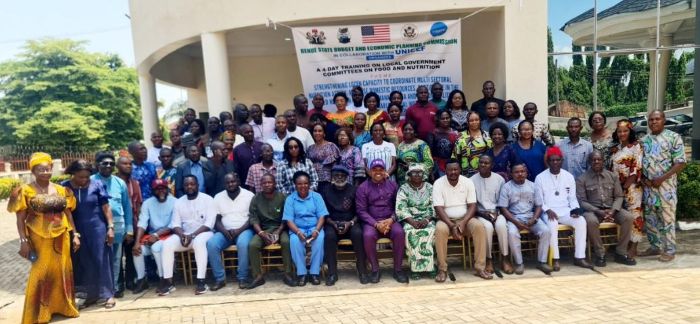
The Benue State Budget and Economic Planning Commission (BSBEPC), in collaboration with the United Nations Children’s Fund (UNICEF) Nigeria, Enugu Field Office, has trained Local Government Committees on Food and Nutrition (LGCFNs) on ways to enhance their capacity in Benue State.
NewsBits reports that the workshop attracted Local Government Chairmen, members of LGCFNs and other key stakeholders to strengthen their capacity to coordinate multisectoral nutrition interventions and translate state and national nutrition priorities into practical action at the grassroots.
The four-day event was held at the NANN Complex Hall in Makurdi, the Capital of Benue State.
NewsBits learnt that the training focused on strengthening local government structures to coordinate nutrition actions, mobilise domestic resources, improve data management and accountability, and develop practical annual nutrition work plans for their respective Local Government Areas (LGAs).
Also, attention was further given to mapping available resources and interventions, including opportunities under the Domestic Resource Mobilisation (DRM) and Child Nutrition Fund (CNF) frameworks.
Delivering his lecture, the Lead Facilitator, UNICEF Independent Consultant on Public Finance for Children (PF4C), Dr. David Okelue Ugwunta, provided a practical framework for connecting nutrition governance with financing, implementation and accountability.
Dr. Ugwunta emphasised that nutrition “is a shared responsibility requiring effective collaboration among government institutions, sectors, development partners and community structures” rather than being treated solely as a health-sector concern.
According to him, effective multisectoral coordination “enables stakeholders to identify gaps, minimise duplication, maximise available resources and ensure that interventions are better targeted to vulnerable populations.”
Ugwunta’s facilitation further linked coordination to the practical realities of resource mobilisation and public financial management. Also, participants were guided to think beyond identifying nutrition needs to be asking “how those needs could be translated into costed activities, budget lines, domestic resource mobilisation actions and realistic annual work plans.”
Dr. Ugwunta’s presentation also highlighted the importance of budget advocacy, nutrition budget tagging and accountability for releases and expenditure.
His submission equally emphasised that securing a budget allocation is only the beginning. “Nutrition resources must be tracked from budget to release, expenditure and implementation, while commodities must be monitored through the supply chain to ensure that intended beneficiaries receive them,” Ugwunta stressed.
He further connected domestic financing to the Child Nutrition Fund (CNF), stressing the importance of understanding eligibility requirements, counterpart financing and the steps LGAs need to take to access co-financing opportunities, while stressing the need to translate financing commitments into measurable actions.
The Lead Facilitator, UNICEF Independent Consultant, also highlighted the importance of “protecting nutrition funds and commodities from diversion and weak controls, introducing practical accountability principles to reinforce that effective nutrition financing goes beyond mobilising resources to ensuring they are properly managed and ultimately reach the women and children for whom they are intended.”
Also speaking during the workshop, the Director General of the BSBEPC, Professor Jerome Andohol, underscored the importance of strengthening nutrition interventions in view of the unfavourable infant mortality situation in Nigeria. Prof. Andohol said that the Benue State Government was investing resources in addressing malnutrition because of the “critical role nutrition plays in child survival, growth and development”.
He stressed that investment in children was an investment in the future of Nigeria and called for early action involving government and relevant stakeholders. Andohol also emphasised the importance of ensuring that child nutrition resources were effectively utilised and translated into tangible benefits in communities.
He urged participants to apply the knowledge and skills acquired during the training in their respective LGAs. He appreciated the Governor of Benue State, Very Rev. Fr. Hyacinth Iormem Alia, for providing an enabling environment that contributed to the successful organisation of the workshop.
The Permanent Secretary of the BSBEPC and Chairman of the State Committee on Food and Nutrition, Mr. Orinya Orgenyi, described food and nutrition as “fundamental to the wellbeing, productivity and future development of the population.”
Orgenyi stressed that Benue’s agricultural potential must be matched by improved nutrition outcomes, and called for greater attention to “children, pregnant and breastfeeding women and other vulnerable groups.”
He emphasised that improved nutrition could not be achieved through the health sector alone, highlighting the importance of collaboration across health, agriculture, education, water resources, social protection, and women and social development. He also urged LGCFNs to prioritize nutrition in their plans, budgets and development programmes.
NewsBits reports that the collaboration with UNICEF Nigeria, Enugu Field Office, reflects UNICEF’s broader role in supporting government-led efforts to improve nutrition outcomes through technical assistance, capacity strengthening, resource mobilisation, particularly through the Child Nutrition Fund (CNF), evidence-based planning, accountability and multisectoral coordination.
It was learnt that UNICEF’s technical support focused not only on nutrition interventions themselves, but also on strengthening the systems required to finance, coordinate, implement and monitor them effectively.
This included helping participants understand how LGCFNs can identify nutrition priorities, map available resources, advocate for domestic budget allocations, strengthen linkages with the Child Nutrition Fund, improve accountability for funds and commodities, and use data to guide decisions.
In his goodwill message, the Benue State Team Lead of Helen Keller International, Mr. Wilson Ameh, emphasised the importance of nutrition-specific interventions, particularly those addressing micronutrient deficiencies and providing essential vitamins.
He noted that the training would strengthen LGCFNs’ understanding of their responsibilities and improve coordination with relevant sectors, while stressing the importance of effective monitoring and evaluation and the use of implementation evidence to strengthen decision-making at the local government level.
The workshop featured technical presentations from government institutions and academia, with Mrs. Ann Tor of the State Primary Health Care Board highlighting the importance of the first 1,000 days of life, from conception to a child’s second birthday, for physical growth, brain development, and long-term health.
Mrs. Apeh Martha, Director in the Planning and Development Department of the BSBEPC, presented on the National and Benue State Nutrition Policy and Strategy, with emphasis on the role of LGAs in translating policy priorities into programmes and activities at the grassroots.
Dr. Mrs. Evelyn Tersoo Abiem of Joseph Sarwuan Tarka University, Makurdi, addressed nutrition governance, focusing on the coordination and accountability relationship between the State Committee on Food and Nutrition (SCFN) and Local Government Committees on Food and Nutrition (LGCFNs), as well as the importance of clearly defined institutional roles.
Mrs. Ruth Asor, Monitoring and Evaluation Officer, led a session on nutrition data, monitoring, evaluation and reporting under the theme “From Data to Decision,” emphasising the importance of generating reliable data and using it to inform planning, resource allocation and effective programme implementation.
The four-day workshop provided participants with an integrated understanding of nutrition governance, policy implementation, resource mobilisation, data management, monitoring and evaluation, accountability and annual work planning.
A key outcome was the opportunity for participants to clarify the respective roles of SCFNs and LGCFNs and strengthen the link between state-level policy and grassroots implementation. The organisers expect participants to return to their LGAs with improved capacity to coordinate nutrition activities, mobilise resources, strengthen community participation, improve reporting and accountability, and develop realistic nutrition work plans that respond to local needs.
The workshop ultimately underscored the importance of sustained collaboration among the Benue State Government, local governments, UNICEF and other development partners, traditional institutions, civil society organisations and communities in advancing nutrition outcomes and improving the survival, development and future productivity of children in Benue State.
