

By Tony Adibe
The Concerned Igbo Peoples Assembly (CIPA) has raised concerns over what it regarded as the purported economic marginalisation and exclusion of Nigeria’s South-East Zone, questioning the distribution of major infrastructure projects across the country in isolation of the Igbo region.
“If they can lay pipelines from Imo to Kano, over 700km, why can’t they lay 200km pipeline to connect all Igbo states together?” the group asked in a press release issued on Saturday.
In a terse press release signed by the CIPA President, Mazi Echezona Ezeonu, the pro-Igbo group expressed serious worry over ongoing and planned gas infrastructure, the development of the Gateway Deep Seaport in Ogun State and the recent establishment of the Economic and Financial Crimes Commission (EFCC) Zonal Directorate in Awka, Anambra State.
The Assembly bemoaned what it called a bitter ironical fact that while major infrastructure is being developed to move gas to other parts of Nigeria, there is no gas infrastructure connecting the five South-East states and supporting industrial development within the region.
CIPA questioned strongly why, gas-producing areas in the South-East could not be connected through pipelines linking Imo, Enugu, Ebonyi, Abia and Anambra states. Again, the group asked : “If they can lay pipelines from Imo to Kano, over 700km, why can’t they lay 200km pipeline to connect all Igbo states together?”
The Assembly also expressed concern over the development of the Ajaokuta-Kaduna-Kano (AKK) gas pipeline, arguing that the benefits of Nigeria’s gas resources should extend more directly to producing and neighbouring communities.
Available industry information, however, shows that the AKK pipeline is a 623km project linking Ajaokuta, Abuja, Kaduna and Kano, while the broader Trans-Nigeria Gas Pipeline project is planned to connect gas-producing areas in the South with demand centres further north.
CIPA further cited the recent development of the Gateway Deep Seaport in Ogun State as another example of what it considers an infrastructure gap in the South-East.
The Ogun State Government and DP World signed memoranda of understanding in September 2026 for the development of the Gateway Deep Seaport and a 10,000-hectare Blue Marine Special Economic Zone, with the Federal Government saying the projects are expected to attract more than $7 billion in initial investment.
The Assembly contrasted the port development with what it described as the absence of a functional seaport serving the South-East, saying the region requires infrastructure capable of supporting production, exports and industrialisation.
CIPA lashed out at the authorities for the establishment of the EFCC’s new Zonal Directorate in Awka, describing the development as evidence of a pattern in which security and enforcement institutions receive attention while economic infrastructure receives less attention.
The EFCC’s Awka Directorate was commissioned on Friday October 2, 2026, and is designed to serve Anambra and Imo states. The commission said its expansion was intended to bring enforcement activities closer to citizens, businesses and government institutions. The pro-Igbo Assembly, however, said the South-East needed more than enforcement infrastructure, calling for greater investment in transportation, energy, gas utilisation, ports and industrial infrastructure.
“What belongs to us is taken to develop other regions, while what they are quick to bring to our land is EFCC office, more police checkpoints, and more army barracks,” the group alleged. It described the situation as “economic strangulation” and urged Igbo leaders and stakeholders to speak collectively on the development needs of the region.
The Concerned Igbo Peoples Assembly said the objective should be to ensure that the region’s natural resources contribute directly to local industrialisation, employment and economic growth. “Ndi Igbo, we need to rise up and speak with one voice. Our gas must develop Igboland first. Our resources must work for us,” the statement said.
The group therefore called for what it described as a comprehensive infrastructure strategy for the South-East, including gas pipelines connecting the states, improved rail connectivity, seaport development and infrastructure capable of transforming the region from a largely consuming economy into a stronger production and export base.
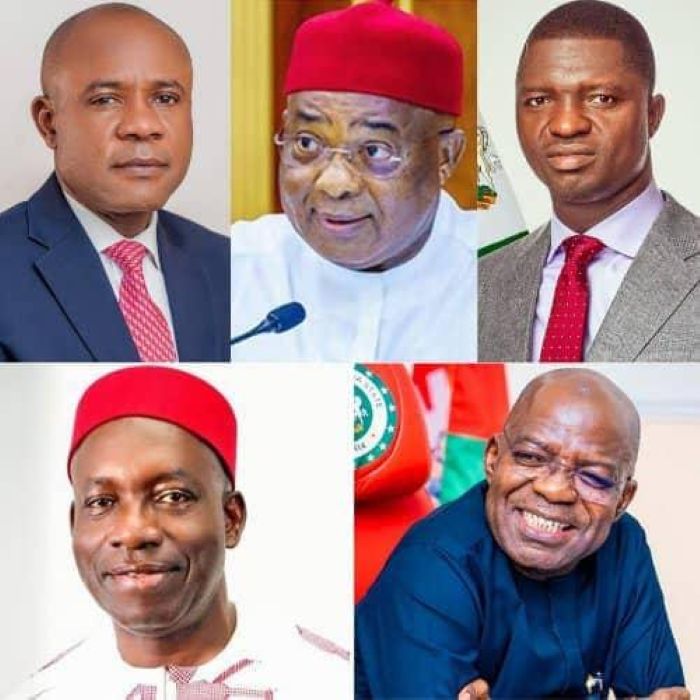
Do the Igbo governors discuss the exclusion of Southeast from the gas project deposit in Igboland but channelled to Ajaokuta, Abuja, Kaduna and Kano?
