


By Tony Adibe
In an inspiring, jaw-dropping, thought-provoking public lecture that left the huge audience shocked, Prof. Frederick Odo Eze, Professor of Public Administration, Department of Public Administration, Enugu State University of Science & Technology (ESUT), Enugu has described the Local Government System in Nigeria as “a Poisoned Chalice.” Prof. Eze bemoaned the third-tier system currently operating in Nigeria for being “under curse.”
But Eze discovered in his study of the third tier, a deep-seated structural malaise he tagged the “resource curse” syndrome. He also emphasised that the local government system “remains the perennial sick baby of governance in Nigeria.”
GENESIS OF THE LOCAL GOVERNMENT TROUBLE
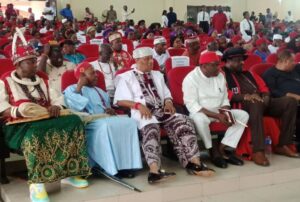
Delivering the 60th Inaugural Lecture 2026 of ESUT inside the Governor Peter Mbah spacious auditorium at the permanent site, Agbani, Prof. Eze, whose lecture was themed, “Beyond The Autonomy Question, Local Government Resource Allocation & Utilization in Nigeria: Changing The Narrative,” carefully traced the genesis of local government administration right from the British Colonial era under Lord Frederick Lugard (Native Administrative System and Indirect Rule System), through the military regimes under Murtala Muhammed/Olusegun Obasanjo,(299 LGAs) to the civil administration of Shehu Shagari (301LGAs) and back again to the military junta of Ibrahim Babangida (589LGAs) to Sani Abacha (774LGAs).

Making a thorough assessment and evaluation of the third tier, the don described local government system as globally recognised as the cradle of democracy and development in the modern world, adding that it’s the government closest to the people. He regretted, however, that the history of governance at the local level in Nigeria has been marked by “a cycle of burbles and bursts” in terms of stability and service delivery.
“From colonial times, to the present day, every successive Nigerian government usually found itself in real quandary on how to handle the Nigerian local government system. The major milestones of Nigerian political history are replete with several models, strategies and frameworks of local government administration which were tried, refined, reformed, tried again and discarded with disastrous consequences for the people,” he lamented.
He recalled that the country operated variegated local government systems in the different regions and later states from the colonial times up till 1976 (under Obasanjo) when a unified local government system was adopted.
However, today the unified system has been jettisoned, Eze said, recalling that there has been brief seasons of relative local government autonomy but over the years, “subordination, intimidation and limited autonomy should better describe the relationship between local governments and the superior tiers of government in Nigeria.”
He said: “Perhaps it is trite to state that the Nigerian local government system is the guinea pig of Nigeria democratic experiment. It has established itself as a willing tool, and a sounding board where politicians in the superior tiers of government (be they military or civilian), try out and perfect their intricate and complex political maneuvers leaving the masses flustered.”
Referencing historical precedents from the native authority era under Lugard to the evolution of the 774 local government areas, Eze maintained that massive financial allocations—with monthly inflows ranging between ₦500 million and ₦700 million per council—have inadvertently turned into a curse. Between 1999 and 2002, approximately ₦4.2 trillion in local government allocations was estimated to have been diverted, misappropriated, or heavily filtered through joint accounts before reaching grassroots communities.
”The local government remains the perennial sick baby in the government structure of Nigeria,” said Eze, emphasising that despite Supreme Court verdict affirming direct allocations, state-level interference, caretaker committees, and grand corruption continue to strangulate grassroots development across Nigeria.
THE WAY OUT OF THE LOGJAM: It is noteworthy that the erudite Professor Eze proferred solutions to the cankerworm he has so vehemently condemned – the termites that have eaten deep into the fabric of the local government system in Nigeria over the decades. He called his well-researched solution the “Eze Model” for Sustainable Grassroots Development.
In order to halt the perennial cycle of financial misappropriation and infrastructural decay witnessed in the third tier of government, the University don unveiled a revolutionary policy roadmap named the “Eze Model” of Federal Revenue Utilization. In the model, Eze advocated a strategic restructuring of monthly local government statutory allocations thus: 40% for Salaries and Overhead: Transferred directly from the office of the Accountant General of the Federation to local governments strictly for the purposes of personnel and operational needs to maintain administrative stability.
60% for Capital Projects via a Federal Grants Board: Diverted into a newly proposed Federal Grants Board (or state-level equivalents) dedicated strictly to capital projects in health, education, water supply, and rural infrastructure. “Quarterly, the total amount of funds in the envelope of each local government shall be determined and communicated to the local government,” according to Eze.
Supporting the “Eze Model” is the local government project identification that will take a bottom-up approach. Eze propounded that annually, local government officials would conduct a Visit Every Community (VEC) program during when local leaders and stakeholders will identify five priority projects needed by each community. These projects are subjected to competitive bidding, strict oversight by an independent board comprising anti-corruption agencies such as EFCC, ICPC, and professional bodies like ANAN, ICAN, NBA, NSE, NGF, ALGON, NULGE, NIQS, and a strict execution process.
“This model provides a fence and a firewall around the federal statutory allocation to local governments in Nigeria,” Eze stressed. “It reduces to the barest minimum the quantity of floating funds susceptible to instances of grand corruption, eradicating the resource curse syndrome that has crippled our rural communities.”
Comparing it with the successful Education Trust Fund (now TETFund), the Professor of Public Administration insisted that if sustained over ten years, the “Eze Model” would bridge infrastructural deficits, curb rural-to-urban migration, generate millions of jobs for unemployed youths, and restore faith in democratic governance from the grassroots up.

“The desirability of a virile local government system in Nigeria is not in doubt but the elephant in the room is the ‘modus operandi’ of the operators of the system. Since the colonial times, the local government system remains the perennial sick baby of governance in Nigeria,” said Eze, who was quick to add: “In spite of the untidy provisions of the 1999 Constitution regarding the local government system, there are enough resources for better outcomes if the attitude of the operators would permit. The paper believes that the problem of the local governments began with the introduction of revenue allocation in 1976.
The paper recommends the application of the Eze Model, which advocates for the abolition of the usual monthly revenue allocation to the local governments but rather adopt a Federal Grant System tied specifically to development projects and programs in specific communities within the local government.” Eze’s thought-provoking, landmark policy framework aimed at ‘recovering’ Nigeria’s grassroots governance from what he termed a “poisoned chalice” earned him a standing ovation that lasted several minutes.
NewsBits reports that regardless of the benefits outlined, whether the Nigerian authorities will adopt the Eze Model in running the local government system is left to be seen.
