

By Tony Adibe
The United Nations Children’s Fund (UNICEF) has described good, quality nutrition as an essential factor in the physical growth, mental development, and overall well-being of children, especially during the first 1,000 days of life.
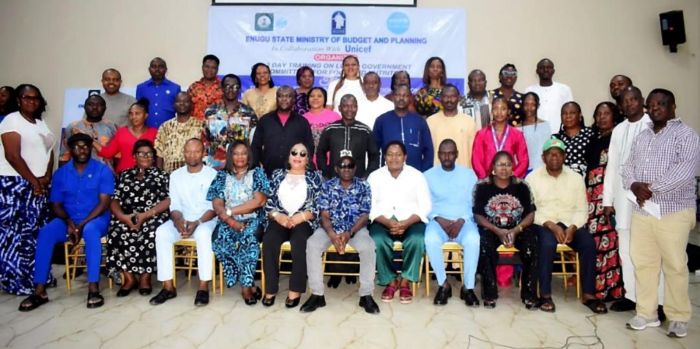
A Nutrition Specialist, Mrs. Ngozi Onuora, who spoke on behalf of the UNICEF Enugu Field Office, made the assertion while addressing participants during a 2-Day capacity-building workshop held at the Dannic Hotel and Suites, New Haven, Enugu, for Local Government Committees on Food and Nutrition (LGCFNs) drawn from the 17 council areas of Enugu State.
Onuora emphasised the importance of sustained collaboration between government and development partners, adding: “Together, we can give every child in Enugu State the opportunity to survive, grow and thrive.”
NewsBits learnt that the training comes seven months after UNICEF handed over essential nutrition commodities to Enugu State, alongside calls for stronger last-mile distribution, accountability and local government ownership of nutrition interventions.
Also, it was gathered that the workshop follows UNICEF’s commendation of Enugu for its early investment in multiple micronutrient supplements through the Child Nutrition Match Fund, with renewed calls for stronger accountability, commodity tracking, and LGA ownership of nutrition interventions.
Therefore, there was a strong collaboration between the Enugu State Government and UNICEF in training Local Government Committees on Food and Nutrition (LGCFNs) on how to “plan, budget, finance, implement and monitor nutrition interventions at the grassroots”, in a renewed push to translate Enugu’s nutrition commitments into sustained and accountable service delivery.
One key part of the workshop focused on the crucial link between public finance and nutrition service delivery. Meanwhile, addressing participants, UNICEF’s Independent Consultant on Public Finance for Children, Dr. David Okelue Ugwunta, facilitated sessions on aligning nutrition priorities with the budget cycle, identifying relevant budget lines and integrating nutrition interventions into Local Government annual operational plans.
Dr Ugwunta, who was the immediate past Commissioner for Budget and Planning, Enugu State, emphasised that sustainable nutrition interventions must move beyond general policy commitments to become clearly identified priorities, properly costed activities, domestic resource commitments, deliberate budget provisions and timely releases within State and Local Government plans.
He stressed that the “effectiveness of nutrition financing must be assessed not merely by what governments appropriate, but also by what is released, spent, implemented and ultimately delivered to beneficiaries.”
Referencing the Enugu State Third Quarter 2026 Budget Implementation Report, Ugwunta demonstrated the distinction between budgetary provision and actual expenditure. The Consultant highlighted eight identified nutrition-related project lines with an initial aggregate provision of approximately ₦1.69 billion, against which no expenditure had been recorded by the end of September 2026.
Ugwunta equally drew attention to the reduction in the provision for Albendazole and Multiple Micronutrient Supplements (MMS) procurement from approximately ₦1.03 billion to ₦30 million, contributing to a reduction in the revised aggregate provision for the eight project lines to approximately ₦690 million.
Giving a broader institutional perspective, he also examined the expenditure profile of the Enugu State Primary Health Care Development Agency (EN-SPHCDA). The Agency recorded cumulative expenditure of approximately ₦9.15 billion by September 2026, including about ₦3.73 billion in the third quarter.
Ugwunta said that a substantial component of the Agency’s expenditure related to the State’s Type 2 Primary Healthcare Centres programme, including approximately ₦4.92 billion for construction earlier in the year and ₦3.59 billion for equipment in the third quarter.
He explained that the Agency’s overall expenditure reflected its broader primary healthcare responsibilities and should be distinguished from expenditure on specific nutrition interventions. The comparison, he stressed, highlighted the importance of ensuring that nutrition priorities receive deliberate attention throughout the budget cycle, from appropriation and budget revision to fund releases, expenditure and service delivery.
Ugwunta further cautioned that the published budget implementation report provides expenditure information but does not establish the release position of individual project lines.
Consequently, zero expenditure entries should prompt further verification rather than be interpreted as conclusive evidence that funds were not released or that services were not delivered. He emphasised the need to examine releases, procurement records, commodity availability and distribution, and implementation reports to establish the full picture.
The expert advised LGCFN members to “strengthen institutional collaboration, work closely with sectoral departments and engage Local Government leadership to ensure that nutrition interventions are identified, costed, incorporated into annual operational plans and budgets, adequately financed, implemented and monitored”.
Ugwunta also advocated regular reporting of progress and results to the State Committee on Food and Nutrition and relevant development partners.
The Consultant on Public Finance for Children concluded that government ownership and domestic resource mobilisation are indispensable to sustaining nutrition programmes beyond external partner support. According to Ugwunta, while development partners provide valuable technical and financial assistance, lasting improvements in nutrition outcomes require governments to progressively assume responsibility for financing, implementation and accountability.
However, the Enugu State Commissioner for Budget and Planning, Barr. Chris Robert Ozongwu, was represented at the opening ceremony by the Permanent Secretary of the Ministry, Mrs. Clara Nwakaego Eze, who commended UNICEF for its support towards improving nutrition outcomes at the community level.
Eze reaffirmed the State Government’s commitment to strengthening nutrition governance and ensuring that interventions reach vulnerable mothers and children.
NewsBits reports that the training covered the roles and responsibilities of LGCFN members, State, LGA and ward-level nutrition profiles for identifying and targeting vulnerable populations, the national food and nutrition security situation, and the committees’ mandates and operational responsibilities.
Delivering a goodwill message on behalf of the Federal Ministry of Budget and Economic Planning (FMBEP), Dr. Olalekan Adedun underscored the broader policy significance of strengthening grassroots nutrition governance and ensuring that government interventions produce tangible benefits for households.
The workshop built on an earlier milestone in Enugu State’s nutrition financing efforts. On 31 March 2026, UNICEF Country Representative, Ms. Wafaa Saeed, handed over 2,803 cartons of small-quantity lipid-based nutrient supplements (SQ-LNS), 843 cartons of ready-to-use therapeutic food (RUTF), and multiple micronutrient supplements (MMS) for pregnant women to the State.
The commodities were procured under the Child Nutrition Match Fund (CNF), through which the Enugu State Government contributed ₦160 million, matched by UNICEF with an additional ₦160 million, bringing the combined financing to ₦320 million.
Recall that during the March handover, Ms. Saeed commended Enugu for being among the first states to procure MMS and among the few prioritising preventive nutrition interventions through the procurement of SQ-LNS. She described the State’s commitment as a model for strengthening maternal and child nutrition. Saeed also referenced the increase in stunting among children under five in Enugu State, from 12 per cent in 2013 to 15 per cent in 2024, as further evidence of the need to scale up high-impact interventions during the first 1,000 days of life.
UNICEF had urged the State to ensure timely last-mile distribution of the commodities, strengthen tracking and accountability systems, sustain community sensitisation and accelerate Local Government ownership of the State Multisectoral Plan for Nutrition through the N-774 initiative. It also called for sustained budgetary commitments, noting the inclusion of MMS procurement in the State Primary Health Care Development Agency’s Annual Operating Plan.
NewsBits reports that the October workshop therefore represented an important step in connecting earlier investments in nutrition commodities with stronger local planning, financing and accountability systems. Its ultimate success will depend on whether LGCFNs can translate the knowledge acquired into functional coordination structures, identifiable budget commitments, timely implementation, and verifiable results for mothers and children across Enugu. This would determine the real success of the capacity-building workshop.
