

By Tony Adibe
A former Minister of Foreign Affairs, Hon. Dr Geoffrey Jideofor Onyeama, and the Head of Department of Mass Communication, Enugu State University of Science and Technology (ESUT), Agbani, Dr Maxwell Menkiti Ngene have charted ways the press can help in sustaining democracy, especially as Nigeria approaches the 2027 general elections.
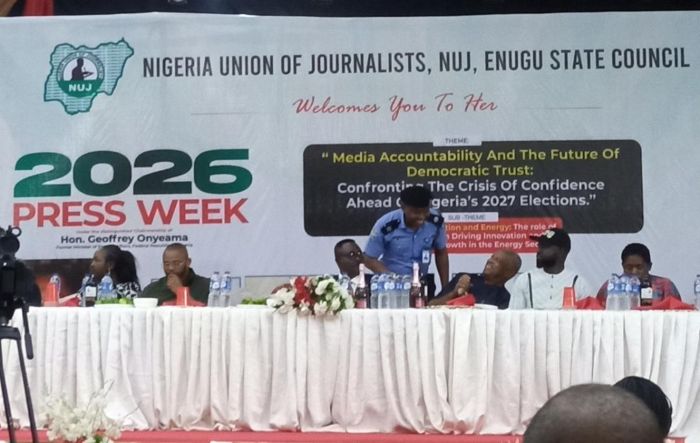
Both the international diplomat and the university Don spoke during the Nigeria Union of Journalists (NUJ), Enugu State Council grand finale of its 2026 Press Week held inside the dome of the International Conference Centre (ICC), Independence Layout, Enugu on Thursday, 5 November 2026.
NewsBits reports that Onyeama spoke as chairman of the occasion, and a former Minister of Energy, Prof. Barth Nnaji, was the Guest Speaker, while Ngene spoke as the Keynote Speaker. The event was themed: “Media Accountability & The Future Democratic Trust: Confronting the Crisis of Confidence Ahead of Nigeria’s 2027 Elections.” The sub-theme was “Media Innovation & Energy: The Role of the Media in Driving Innovation & Sustainable Growth in the Energy Sector,” and it was handled by Nnaji’s representative.
In his opening remarks, which turned out to be a further discussion on the main theme, Onyeama advised the Nigerian media practitioners to always uphold the ethics of the profession, explaining that journalism was a noble responsibility that required “integrity, accuracy and professionalism”.
According to the former Minister, media accountability “plays a critical role in strengthening public confidence and democratic trust,” adding that “once the press loses that public confidence and trust,” the people will no longer believe the credibility of the media.
He insisted that the media could either rebuild public trust through accurate and credible reporting or deepen public mistrust through fake news, disinformation, misinformation, and biased reporting.
Urging members of the press to ensure the verification of information before rushing to publish, the former Minister said newsrooms ought to rely on credible and authenticated reports only.
Editors, he said, must at all times protect their sources, guard against manipulated media and make sure that journalism professional standards are upheld. On election reporting and guidelines, Onyeama further advised journalists to adhere strictly to established election reporting guidelines during elections.
He also pleaded with the governments at all levels to ensure the safety and protection of journalists in the discharge of their official and constitutional duties. The work of the journalist is enshrined in the constitution of the Federal Republic of Nigeria, Onyeama observed.
Reading the keynote speech themed, “Media Accountability and the Future of Democratic Trust: Confronting the Crisis of Confidence Ahead of Nigeria’s 2027 Elections,” Ngene explained that democratic governance extends far beyond periodic balloting and administrative procedures.
Ngene, just like Onyeama, said that the survival of Nigeria’s constitutional democracy and the credibility of the forthcoming 2027 general elections depended heavily on a free, independent, and ethically accountable press. Ngene made a passionate appeal to media houses to set up fact-checking desks in their various newsrooms to ensure the veracity of information.
The Mass Communication lecturer emphasised the need for editors to uphold professional standards in the “selection, verification, presentation and correction of news reports.”
Urging media practitioners to demonstrate accountability, transparency, fairness and accuracy in the discharge of their responsibilities, the communication scholar said that media accountability “goes beyond professional competence, requiring ethical judgment, transparency, fairness, accuracy and a willingness to accept responsibility for errors.”
Ngene insisted that the relationship between the media and the electorate “remains pivotal to preserving public order and democratic legitimacy.” The lecturer argued that whereas periodic elections, constitutional structures, and political parties exist, a crisis of public confidence in media reporting threatens the entire democratic network.
He said: “The media is too important to democracy to be treated merely as a commercial enterprise, a political instrument or a collection of competing news organisations.”
He explained that the press was a public institution in the service of society, stressing that its institutional credibility remains essential to elevating public discourse and holding leadership accountable.
Ngene, who tapped his combined experience as a university scholar, media-sector administrator, and former national leader in the Radio, Television, Theatre and Arts Workers Union of Nigeria (RATTAWU), however, cautioned against viewing press freedom in isolation from responsibility.
Ngene said: “My position is straightforward: democracy requires an accountable media, but an accountable media also requires a free, independent, professionally protected and economically sustainable environment. Neither responsibility nor freedom should be sacrificed at the expense of the other.”
The University Don further focused on electoral credibility, insisting that it “is a shared responsibility” involving the Independent National Electoral Commission (INEC), political parties, security agencies, the judiciary, and the press. He implored various media bodies, media executives, and policymakers to establish robust self-regulatory mechanisms and improve the economic welfare of journalists to safeguard professional integrity.
In his opening remarks, the Chairman of the NUJ, Enugu State Council, Comrade Obinna Ogbuka, lauded the Enugu State Government for its continued support to the union. According to Ogbuka, there has not been a case of harassment of journalists in the state since the current Governor Peter Mbah-led administration came into office.
He, however, pleaded with the state government, politicians and other stakeholders to support the provision of a bus for the union and the rehabilitation of the premises of NUJ Press Centre to meet modern standards.
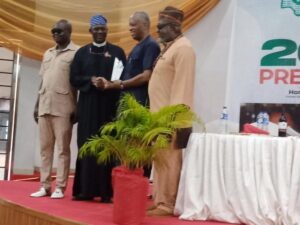
The well-attended grand finale witnessed the presentation of awards to eminent personalities, such as the oil magnate Prince Arthur Eze, as well as his induction into the Enugu NUJ Hall of Fame. Prince Eze was honoured because he alone funded the total renovation and refurbishing of the Press Centre, Enugu, way back in December 1997, which was in deplorable State before his intervention, it was gathered.
NewsBits reports that the NUJ National President, Alhaji Alhasan Yahaya, represented by the Vice President, Zone C, Comrade Ezenwafor Adiukwu performed the induction.
Other awardees included Dr. Geoffrey Onyeama (Award of Excellence in Diplomacy & Administration); Professor Barth Nnaji (Icon of Excellence & Innovation Award); Senator representing Enugu North, Ikeje Asogwa (Champion of Educational Transformation & Community Development Award), he was represented by his Media Aide, Mr. Samson Ezea, and numerous others.
The Enugu State Governor, Dr. Peter Mbah, was represented by his Special Adviser on Media, Mr. Onyekwere Nwobodo.
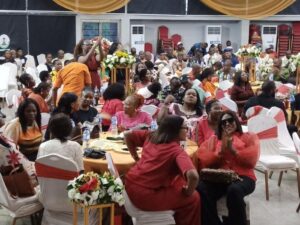
NewsBits reports that over 1,000 guests, comprising state executive officers, media veterans, academics, religious and political leaders, attended the event, said to be the first to attract such a huge crowd since the hosting of NUJ Press Week in recent years.
