

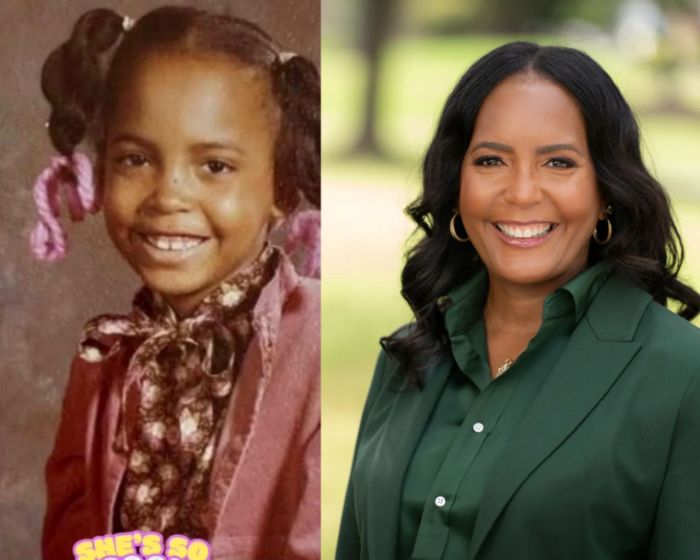
In 1860, Sheppard Peek was recorded as property in Georgia, with a monetary value assigned to his life. More than 160 years later, his great-great-granddaughter was elected to lead the same state. On the eve of her historic victory, Keisha Lance Bottoms returned to the town where her family’s documented history began and wept at the grave of her enslaved ancestor.
In 1860, a white plantation owner in Crawfordville, Georgia, placed a value of $1,400 on an enslaved man named Sheppard Peek. His name appeared among the owner’s possessions in surviving records. In another document, where he was required to sign his name, Sheppard marked the page with an X.
The records preserve a brutal account of how slavery reduced human beings to property, assigned monetary values, and denied them the most basic freedoms. More than 160 years later, Sheppard Peek’s great-great-granddaughter, Keisha Lance Bottoms, was elected governor of Georgia.
On November 3, 2026, Bottoms made history as the first Black woman elected governor of an American state, winning the race against Republican businessman Rick Jackson. She will also become Georgia’s first female governor.
But the moment that gave her victory its most personal meaning came the day before the election, when she returned to Crawfordville, the small town about 90 miles east of Atlanta where her family’s traceable history reaches back at least five generations.
There, she visited the cemetery where her great-great-grandmother, Betsy Peek, is buried among generations of African Americans, many in unmarked graves.
She knelt at the grave and wept.
A family history written in the records of slavery
Bottoms has described herself as at least a fifth-generation Georgian. Her family’s documented history leads back to a plantation in Crawfordville and to Sheppard and Betsy Peek, her great-great-grandparents.
Betsy was born in 1845, when slavery remained legal in Georgia. She lived through emancipation and the uncertain years that followed, as formerly enslaved people sought to build lives and families in a society that continued to deny Black Americans equal rights.
The surviving records of Sheppard’s enslavement offer a particularly stark glimpse into that past. His valuation of $1,400 was recorded as though it were an ordinary item in an estate inventory. The X on another document speaks to the barriers that prevented enslaved people from receiving the education and opportunities routinely available to white Americans.
Yet the family’s story did not end with those records.
According to Bottoms, her grandmother told her how her parents packed their belongings into a horse-drawn buggy and travelled from rural Georgia to Atlanta in search of opportunity. The family moved from a community shaped by slavery towards a city where successive generations would encounter new possibilities, even as racial discrimination continued to restrict Black life.
The Atlanta they entered was far from an equal society. Black residents faced segregation, exclusion and barriers to economic advancement. The journey from Crawfordville did not erase those obstacles, but it helped carry the family into a new chapter.
The return to Crawfordville
On Monday, November 2, the day before Georgians went to the polls, Bottoms returned to the town where her ancestors had lived. The visit was not simply a campaign stop. She met local residents, spoke about her family’s roots, and went to the cemetery where Betsy Peek was buried.
In a town of about 500 people, the visit connected a nationally watched gubernatorial campaign with a community whose history is closely tied to the family Bottoms had spent years researching.
At the cemetery, she knelt at Betsy’s resting place and cried. The moment brought together the personal and historical dimensions of a journey spanning generations: a woman seeking the grave of an ancestor who had lived under slavery, on the eve of an election that would make her the first Black woman chosen to govern an American state.
The visit also drew attention to Crawfordville’s largely undocumented Black history. Local historian Terry Howard told WRDW that many families in the area have struggled to trace their ancestry because so few records and local historical resources have survived. Bottoms’s return has prompted renewed interest among residents seeking to understand their own family connections to the town.
From the courtroom to the governor’s office
Bottoms’s election did not come without a substantial public career of her own. A lawyer by training, she served as a judge, represented Atlanta’s District 11 on the City Council and became the city’s mayor in 2018. She later served as a senior adviser to President Joe Biden.
Her political journey has taken place in a city with a significant history of Black political leadership. She grew up in Atlanta during the years when Maynard Jackson became the city’s first Black mayor in 1973. Her own election as mayor in 2017 continued that political history.
Her victory on November 3, however, took that journey beyond Atlanta. Defeating Republican Rick Jackson, she won approximately 54 per cent of the vote and ended more than two decades of Republican control of Georgia’s governorship. She will succeed Governor Brian Kemp. The historic nature of her election was reflected in her victory speech, but Bottoms turned attention to the generations who had preceded her.
Speaking about Betsy Peek, she said: “I don’t know what dreams Betsy Peek had for her children or for her grandchildren or the generations that she would never meet, but I know I am standing on shoulders made of steel.”
It was an acknowledgment of a family history that could not be separated from the wider history of Black Americans: slavery, emancipation, segregation, migration, struggle and the gradual opening of political and economic opportunities.
The distance between 1860 and 2026
The contrast is difficult to ignore.
In 1860, Sheppard Peek was assigned a monetary value by a man who claimed ownership over him. His great-great-granddaughter has now been elected by millions of voters to lead the state in which he was enslaved.
Betsy Peek could not have known what political opportunities would become available to her descendants. The generations that followed her carried the family through emancipation, racial segregation, and the struggle for equal citizenship.
Their experiences were not erased by one election, nor does a historic victory mean that the inequalities of the past have disappeared. But Bottoms’s election has placed a documented family history of enslavement alongside a landmark in American political representation.
The journey from the plantation records of Crawfordville to the Governor’s Mansion is not merely a story of one woman’s success. It is also a reminder of the generations whose lives, labour and determination made opportunities possible for those who came after them. On the eve of her election, Bottoms returned to where that documented family journey began. The following night, Georgia voters chose her to lead the state. Sheppard Peek was once valued at $1,400. His descendant will occupy the highest elected office in Georgia.
