

By Tony Adibe
Some key stakeholders in Enugu State comprising the traditional rulers, academics, religious leaders, captains of industry, university students and the politicians themselves on Thursday lauded the four co-authors of a new book on governorship rotation in the Coal City State.
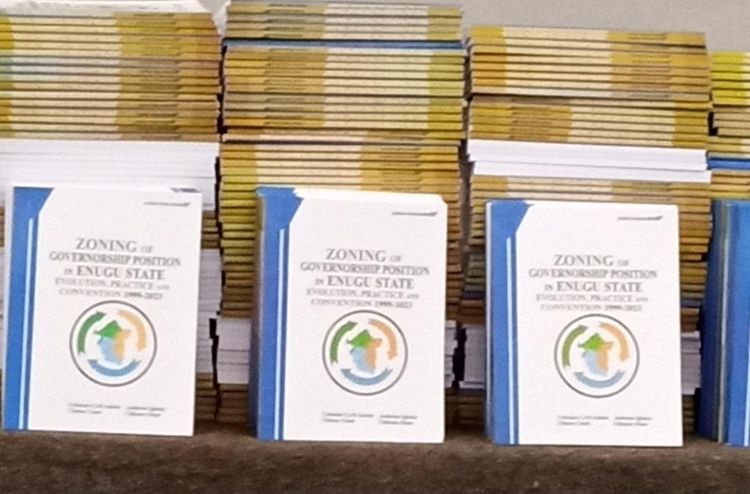
NewsBits reports that the book entitled, “Zoning of Governorship Position in Enugu State: Evolution, Practice and Convention,” was presented to the public after it was unveiled at a historic ceremony held inside the Dome of the International Conference Centre, Independence Layout, Enugu.
The new book, which documents the evolution and impact of the governorship zoning arrangement in Enugu State was described by almost all the speakers as a cornerstone of peace and equity in the state since it would serve as a vital reference materials for both the present and future generations.
Authors of the book include Dr Uche Anioke, Dr. Ambrose Igboke, Dr Chikezie Obasi and Comrade Clinton Umeh – all notable analysts in their own rights were commended for focusing on an issue – governorship rotation which, they said, hitherto lacked reference material as far as politics of the state is concerned.
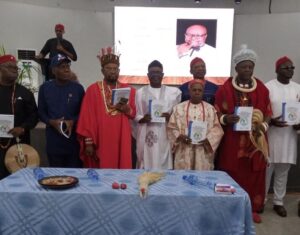
The well-attended event was graced by dignitaries such as notable traditional rulers like HRH, Igwe Lawrence Agubuzu, Igwe Samuel Ikechukwu Asadu, Enugu State APC Chairman, Dr Martin Chukwunwike, and Commissioner for Information Dr. Malachy Agbo, who represented Governor Peter Mbah. Former Governors Sullivan Chime and Ifeanyi Ugwuanyi sent representatives. While Sir Victor Atuonwu stood in for Chime, Prof…. represented Ugwuanyi.
Addressing the gathering, co-author and Managing Director of ACENA Publishers Nig. Ltd, the firm that published the book, Uche Anioke said the publication was born out of a need to document Enugu’s political culture following the controversies that trailed the 2023 governorship race.
According to Anioke, who spoke on behalf of other co-authors, “After the rancorous, toxic and extensive power struggles of the 2023, governorship election, with its attendant misinformation and exaggerated narratives, we, the authors, felt compelled, in good conscience, to embark on extensive research and broad direct interviews to document all the sides to the zoning discourse.”
Anioke recalled that at the beginning of the fact-finding journey, the authors embarked on a search of empirical evidence on the intricate issue of zoning of governorship position in Enugu State.
“With a deep sense of history, we dug deep into the archives and conducted extensive interviews to present an objective, factual, and insightful account that students of political science, policymakers, and the general public will find enormously useful,” he said.
He explained that the authors’ burning motivation was not just to put together another political memoir but an uncommon desire to manifestly capture the spirit of unity, fairness, and mutual understanding that has defined Enugu State’s politics for over twenty years and counting. “The book is already declared by pundits as the “Magna Carta” literature of Enugu State Politics in the 4th Republic,” Anioke remarked.
“Without doubt, the return of democracy in 1999, has witnessed a zoning arrangement of the governorship position in Enugu State, and its transition from a mere gentleman’s agreement into an unwritten convention. It has, since then, remained a powerful instrument of equity, ensuring that power rotates harmoniously among the three senatorial districts of Enugu East, Enugu West, and Enugu North,” said Anioke, who was quick to add: “This convention has not only fostered peace and stability but has also given every segment of our beloved state a sense of belonging in the corridors of power.”
He further said: “Empirically, my co-authors and I have meticulously chronicled the evolution of zoning of the governorship position in Enugu State. We critically analyzed the practical applications, the numerous challenges surmounted, the many conventions established, and the invaluable roles played by our founding fathers, political actors and actresses, traditional rulers, and the good men and women of Enugu State.”
However, while performing the unveiling, Igwe Agubuzu said the rotation of the governorship among Enugu’s three senatorial districts has sustained peace in the state since 1999.
“Rotation among the three senatorial districts has given us peace since 1999. It’s good the book was written and we will learn much from it,” he said.
The book reviewer, Dr. Chinedu Onu explained that zoning in Enugu state was never codified but has operated as a convention rooted in fairness and justice rather than power play. Dr Onu recalled how the then Governor Chimaroke Nnamani, on leaving office, handed over to Barrister Sullivan Chime from Enugu West Senatorial District, who in turn said the seat should rotate to Nsukka when his tenure ended — a move Onu said cemented Enugu’s “tripod” political structure.
The reviewer said: “It has brought peace to us as Wawa people who are peaceful people…Zoning reflects justice and not about power play. It’s a convention that has no written document anywhere but is designed to engender fairness and equity in the polity.”
Onu also recounted the 2023 election period, when groups such as “Ifemelumma” and “Ka’ Isi-Uzo Jie” emerged to challenge the arrangement, but said “at the end, justice prevailed.” While comparing Enugu to Kogi and Benue states – states he argued hardly observed rotation or zoning in their politics, Onu explained that while dominant ethnic groups in those states often exclude smaller groups from power, Enugu has consistently upheld zoning.
Hon. Emeka Ugwuaba, representing the Managing Director of COMAG Group at the book launch, lauded the authors for sparking a vital conversation. “The arrangement has brought peace to us and the authors have penned it down for posterity,” he said. Ugwuaba, however, bemoaned the menace of poor reading culture in the country, which doesn’t help matters.
Capt. Everest Nnaji (Odengene), represented by Chinagorom Egbo, described the work as more than an academic contribution. “It is a commendable voice and compass for future generations in Enugu State,” he said.
APC Chairman Martin Chukwunwike said the documentation of the zoning arrangement would serve as a reference point for the state’s political future. He said: “Now the rotation is documented, and we are all witness to the documentation. I thank the authors for the good work.
