

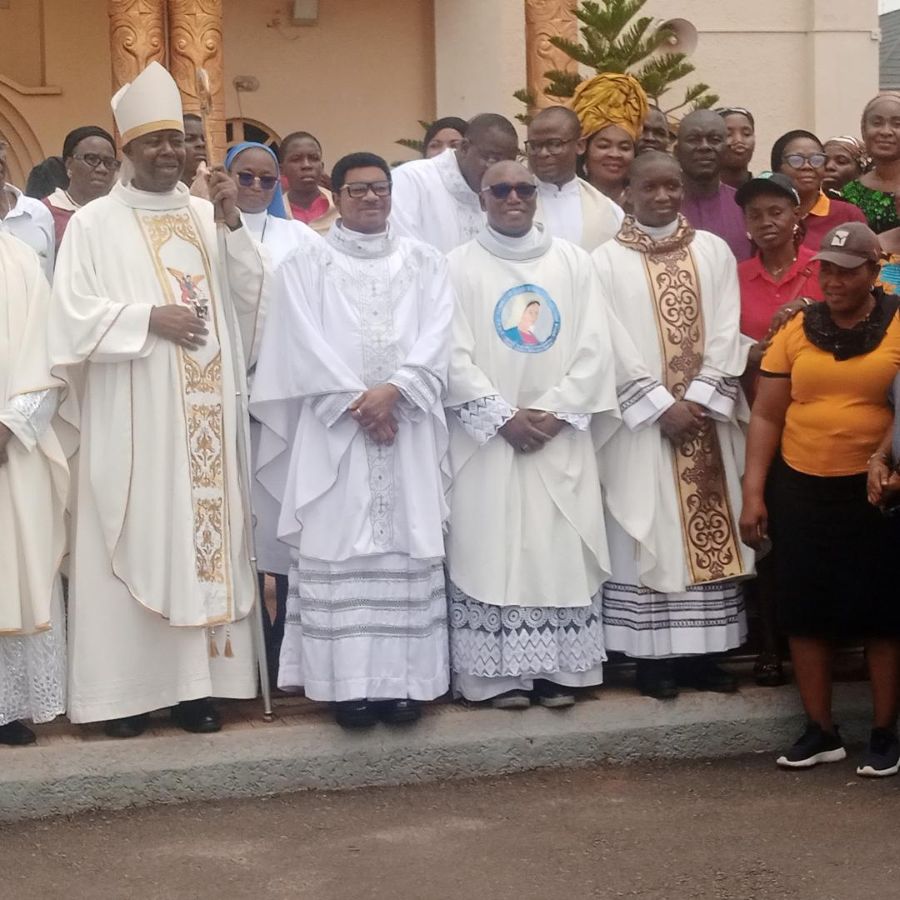
Bishop Callistus Onaga (1 from left) and the others pose for the camera in front of Holy Ghost Cathedral, Enugu
By Tony Adibe
Catholic Diocese of Enugu, Nigeria, on Sunday, joined other Catholic Dioceses worldwide to celebrate the 2026 World Communication Day with an appeal call to Christians and journalists to use communication as a tool for truth, unity, and human development rather than destruction.
NewsBits reports that the World Communication Day is celebrated annually by the Catholic Church globally to reflect on the role of communication in evangelisation, human development, and societal growth. This year’s 60th World Communication Day 2026 was themed: “Preserving Human Voices And Faces”.
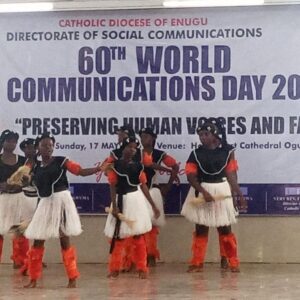
Delivering the homily during the celebration, held at the Holy Ghost Cathedral, Enugu, SouthEast, Nigeria, the Catholic Bishop of Enugu Diocese, Most Rev. Dr Callistus Onaga, warned against the abuse of artificial intelligence and digital technology.
Bishop Onaga emphasised that modern innovations should not replace human identity, values, and natural relationships. He called on communication professionals, media practitioners, and the faithful to uphold truth, morality, and responsibility in the dissemination of information.
Bishop Onaga explained that communication was a divine gift through which God relates with humanity, stressing that “words possess the power to build, create, and also destroy.” He said human voices and faces remain sacred and unique, adding that no technological advancement should take away human originality and dignity.
According to him, “The human voice is unique and different from every other person. Our faces are different and help define our identity. God created us uniquely, and communication helps humanity to relate, build, and preserve society.”
He further explained that while digital technology and artificial intelligence have become important tools in modern communication, their excessive and careless use could negatively affect human relationships, academic integrity, and social interaction.
Onaga was worried that many people, especially youths and students, now depend heavily on artificial intelligence for academic and personal activities instead of developing themselves intellectually and creatively. He warned that over-reliance on AI could weaken research culture in universities and gradually erode human reasoning and originality.
Bishop Onaga also bemoaned the fact that technology was increasingly affecting family and social life, stressing that many people now spend long hours on phones and social media platforms with little or no meaningful interpersonal communication.
He lamented that husband and wife could sit at the same place, chatting with foreigners for hours without talking to each other. According to him, artificial intelligence should only serve as a supportive tool for solving problems and not as a replacement for human nature and relationships.
The bishop further urged Christians to regulate how they use digital platforms and social media in order to protect their identity, values, and mental well-being. The Chairman of the occasion, Prof. Sunny Udeze, in his remarks, maintained that media practitioners must remain committed to communicating the truth to the people at all times.

He said that communication remains the centre of human existence and plays a crucial role in shaping society. He spoke extensively on interpersonal communication, noting that many developments over the years had continued to highlight the importance of responsible information dissemination. Prof. Udeze urged journalists and media professionals to always uphold truth and professionalism in their reports and publications.
Describing the internet as “a forest” filled with “the good, the bad, and the ugly,” he cautioned journalists against the spread of misinformation and unethical content. He challenged media practitioners to always reflect on the legacy they would leave behind after their time on earth.
In his lecture, the Guest Speaker, Associate Professor of Mass Communication and Head of Department of Mass Communication, Enugu State University of Science and Technology (ESUTH), Prof. Chidi Ezima, stressed the need for ethical communication and responsible journalism in the digital age. He advised communicators to always use the media as a tool for peacebuilding, moral reawakening, and societal development.
