

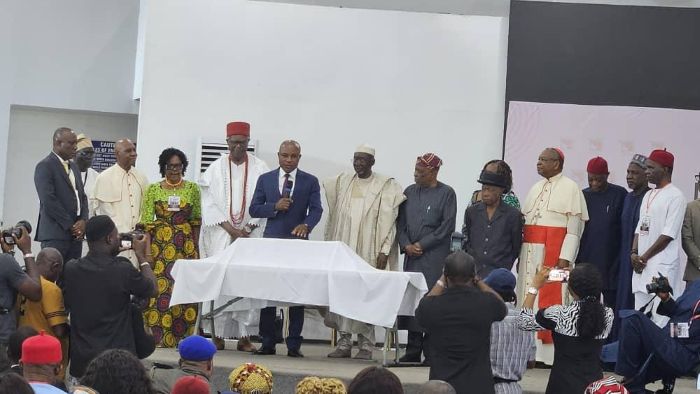
State Governors, traditional rulers, religious leaders, and media executives have converged inside the dome of the International Conference Centre (ICC) in Enugu for the ongoing 22nd All Nigeria Editors Conference (ANEC)organized by the Nigerian Guild of Editors.
NewsBits reports that the development comes against the background of the forthcoming 2027 general elections and a rapidly evolving digital communication system. The theme of the conference is, “The Ballot, the Media and the Task of Keeping Democracy Alive,” with a sub-theme, “When Lies Look Real: Detecting & Debunking A.I Disinformation Before, During & After Election.”
Brainstorming on the theme, major stakeholders made clear the challenge, insisting that Nigeria’s democracy could hardly survive when there was no independent press, an uncorrupted ballot, and proactive defenses against synthetic media and artificial intelligence.
Delivering his keynote address, the Catholic Archbishop Emeritus of Abuja, John Cardinal Onaiyekan questioned the structural deficiencies of Nigeria’s electoral and governance systems.
Cardinal Onaiyekan outlined a seven-point reform agenda for future legislative sessions, advocating for an independent appointment process for the Independent National Electoral Commission (INEC), specialized election tribunals to resolve all disputes prior to swearing-in ceremonies, the introduction of independent candidacy, and a mandatory 50 percent minimum vote threshold for presidential declarations.The cleric reminded the media of its constitutional mandate as the Fourth Estate of the Realm, and advised journalists to operate with professional autonomy and resist external financial or political pressures.
The Chief Host and Governor of Enugu State, Dr. Peter Mbah, welcomed over 300 editors to the state, framing the relationship between government and the press as a shared commitment to public service and truth. Commenting on economic discussions, Governor Mbah clarified that elected officials hold land and resources purely in trust for the citizens.
He outlined Enugu State’s ongoing socio-economic transformation—covering over 1,500 kilometers of road construction, 7,000 classrooms, Type 2 primary healthcare centers across all 260 electoral wards, urban water restoration, and aviation expansion. He invited the journalists to apply rigorous, evidence-based scrutiny to both government successes and shortcomings.
The Chairman of the occasion, His Royal Majesty Igwe Nnaemeka Alfred Achebe, the Obi of Onitsha, described democracy as “a fire lit to keep the house warm” that must be tended continuously.
Igwe Achebe, however, spotlighted the existential threat posed by AI-generated deepfakes, synthetic voice clones, and targeted disinformation ahead of election cycles. The native ruler advised the NGE to establish a joint “Election Rapid Response Desk” to fact-check viral falsehoods in real time, while also challenging editors to prioritize verification over speed and actively foster media literacy across all strata of society.
The Minister of Information, represented by Ali M. Ali, Managing Director of the News Agency of Nigeria (NAN), spoke on behalf of Nigeria’s Federal Government. His remarks underscored the sub-theme: “When Lies Look Real: Detecting and Debunking A.I Misinformation Before, During, and After Elections.”
The minister pinpointed recent economic and infrastructural reforms under President Bola Tinubu’s Renewed Hope agenda, including the Electoral Act amendments signed into law in February 2026. The government urged editors to embed verification deep into newsroom culture, warning that the ultimate danger of AI-driven misinformation is not merely that citizens believe a lie, but that they lose faith in truth and public institutions altogether.
He referenced Daily Trust Newspaper with the motto ‘Trust is a Burden’ and The Guardian Newspapers that has as its own guiding philosophy Uthman Danfodiya’s immortal quote, ‘Conscience is an open wound only truth can heal it’ as the relevance of public trust and confidence in an institution. He said once such trust is lost, the institution is gone, and urged editors to at all times safeguard public trust.
Earlier, in a harsh critique of Nigeria’s electoral and judicial systems, the immediate past President of the Nigerian Bar Association (NBA), Mazi Afam Osigwe, SAN, had announced that Nigerian courts have gradually usurped the statutory power of citizens in determining their elected representatives through controversial legal technicalities.
Delivering an address entitled “Election Petition in the Digital Age: Independence, Evidence, BVAS”, Osigwe bemoaned the growing judicialization of the electoral process, warning that Nigeria’s democracy is being severely undermined by procedural bottlenecks and systemic corruption.
Osigwe said: “I don’t know who chose the topic, and I don’t know why this topic was chosen or rather why I was chosen to talk about it.” He was quick to add: “If you ask me, I will simply say that I was merely asked to come here and talk about the intersection between INEC, the electoral process, evidence, and then the courts.”
He emphasised the crucial role of the judiciary in interpreting electoral laws, adding that judicial rulings have heavily dictated the trajectory of the nation’s governance. He said: “And for me as a lawyer, I think that that’s very important because how the courts have interpreted the laws made have gone a long way in shaping our democracy.”
Osigwe pointed out that Nigeria holds one of the highest numbers of election petitions globally, primarily because politicians rely on tribunals to determine victories rather than the voters. He contrasted Nigeria’s slow judicial machinery with the United States Supreme Court, which decisively stopped President Donald Trump’s executive attempt to alter US Postal Service voting protocols within days. He said: “I don’t know how long such a process would have taken if it were Nigeria, or if our courts would have had the boldness to decide decisively.”
Referencing the literary legend Chinua Achebe, Osigwe linked the logjam in Nigeria directly to leadership failure across all strata of society . According to Osigwe, “Chinua Achebe, in his book ‘The Trouble with Nigeria’, identifies leadership as the problem. Achebe says, ‘The trouble with Nigeria is simply and squarely a failure of leadership.’ And this failure of leadership is found in our homes, in our organizations, and everywhere we work—not just in the presidency or governorships.
Earlier in his opening address, the outgoing President of the Nigerian Guild of Editors (NGE), Eze Anaba, emphasized that political actors are not the sole custodians of the democratic system. Expressing worry for the increasing political intolerance and hate speech, Anaba warned against letting judicial decisions override the sovereign will of voters.
Anaba pleaded with editors to always uphold rigorous verification, independence, and courage, stressing that despite severe economic pressures facing newsrooms, holding power accountable remains an uncompromisable civic responsibility. He also announced that the conference marks his final welcome address as NGE President ahead of the Guild’s upcoming biennial elective conference.
The historic event witnessed the unveiling of a new book edited by Prof. Stella Chinyere Okunna, the Deputy Vice Chancellor of Paul’s University, Awka, and a Fellow of the Nigerian Guild of Editors under whose umbrella the book was produced.
