

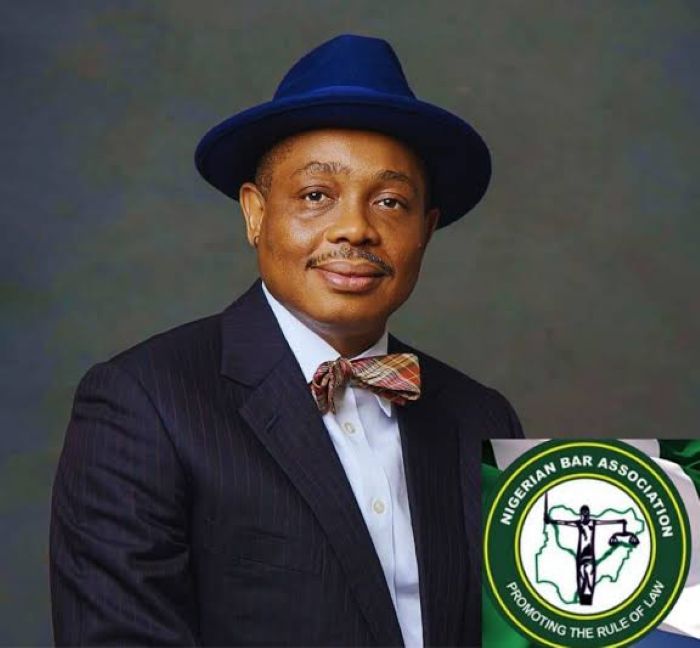
In what seemed like a harsh critique of Nigeria’s electoral and judicial systems, the immediate past President of the Nigerian Bar Association (NBA), Mazi Afam Osigwe (SAN), has said that Nigerian courts have gradually usurped the statutory power of citizens in determining their elected representatives through controversial legal technicalities.
Osigwe was delivering an address entitled, “Election Petition in the Digital Age: Independence, Evidence, BVAS” before an audience of media editors at the ongoing 22nd Nigeria Guild of Editors Conference (NGEC) holding in Enugu. He bemoaned the increasing “judicialization of the electoral process”, warning that Nigeria’s democracy “is being severely undermined by procedural bottlenecks and systemic corruption.”
He said: “I don’t know who chose the topic, and I don’t know why this topic was chosen or rather why I was chosen to talk about it. If you ask me, I will simply say that I was merely asked to come here and talk about the intersection between INEC, the electoral process, evidence, and then the courts.”
Osigwe spotlighted the crucial role of the judiciary in interpreting electoral laws, stressing that judicial rulings have heavily dictated the trajectory of the nation’s governance. He said: “And for me as a lawyer, I think that that’s very important because how the courts have interpreted the laws made have gone a long way in shaping our democracy.”
Recounting a paper presented by a close judicial colleague, the former NBA President agreed that judges have taken over the ballot box.
According to him, “A judge, a very good friend of mine, once presented a paper and called it ‘The Judicialization of the Electoral Process.’ He argued that because of the difficulty of proving non-compliance with the Electoral Act, the courts have gradually and increasingly usurped the role of the voters in determining the representatives of the people. And I couldn’t have agreed with him more.”
Osigwe said that Nigeria holds one of the highest numbers of election petitions globally, primarily because politicians rely on tribunals to determine victories rather than the voters. He contrasted Nigeria’s slow judicial machinery with the United States Supreme Court, which decisively halted former President Donald Trump’s executive attempt to alter US Postal Service voting protocols within days.
He said: “I don’t know how long such a process would have taken if it were Nigeria, or if our courts would have had the boldness to decide decisively.”
Referencing literary icon Prof. Chinua Achebe, Osigwe linked the crisis directly to leadership failure across all strata of society. “Chinua Achebe, in his book ‘The Trouble with Nigeria’, identifies leadership as the problem. He says, ‘The trouble with Nigeria is simply and squarely a failure of leadership.’ And this failure of leadership is found in our homes, in our organizations, and everywhere we work—not just in the presidency or governorships.”
Osigwe also lashed out at his own profession, admitting that legal practitioners often deploy absurd legal tactics that confuse the bench. He said: “When I, as a lawyer, go to court to argue what in some climes would be considered nonsensical, and present an argument that leaves a judge scratching his head, I pray you are able to follow me because I’m not going to move in any particular pattern.”
Focusing on the Independent National Electoral Commission (INEC), established under Section 153 of the 1999 Constitution, he observed a sharp decline in public confidence and voter turnout. He said: “If you check the voter turnout data, increasingly, fewer Nigerians are coming out to participate in elections. It’s because many Nigerians do not believe that whatever votes they cast matter or count.”
He criticized the opacity of night-time collation processes, voter suppression, and ethnic profiling. “They believe that between the polling units where they vote and the announcement of results at collation centers—especially if collation drags into the night—miracles are suspected to have happened before daybreak. So why vote?” Osigwe asked.
He further observed that politicians exploit this public despair by bribing voters with food items and instigating violence through vulnerable youth. “Politicians, knowing that the people don’t have confidence in them, prey on the people by giving them money, salt, and rice, while recruiting helpless young men as thugs to unleash violence,” he lamented.
Osigwe condemned the political influence surrounding INEC appointments, particularly at the state level where local electoral bodies routinely deliver 100% victories to ruling parties. “Whenever people are appointed into the State Independent Electoral Commissions, the ruling party almost always wins 100%. Sometimes you’ll be waiting for ballot papers to arrive, and the results are already announced,” he revealed.
He expressed frustration over how technical judicial interpretations destroyed the promise of technological innovations like the Bimodal Voter Accreditation System (BVAS) and the INEC Result Viewing Portal (IReV). “Because of the difficulty of proving allegations, we introduced smart cards in 2015, and then moved to BVAS and IReV. Everybody said ‘Hooray!’, but then came the shockers from the courts,” he said.
Criticizing Supreme Court precedents on BVAS evidence, Osigwe noted: “The court held that the BVAS machine itself is the primary evidence, not the printout from it. So, if you are challenging a state-wide election, you must physically carry the BVAS from every single polling unit to court within strict time limits. Yet technology was supposed to make it easier for us.”
The former NBA boss also censured the judiciary’s handling of subpoenas in major presidential petition cases, including those of Atiku Abubakar and Peter Obi. “The court’s decision on subpoenas confuses me. When the court said anything a subpoenaed witness did not file within 21 days is inadmissible, it effectively rendered useless the concept of a subpoena. How do you expect an INEC official to willingly sign a witness statement on oath against INEC within 21 days without being suspended?”
He warned that IReV has been reduced to a meaningless screen. “IReV is now treated as a mere viewing portal—like going to a gallery to watch a football match. To make matters worse, proposed electoral law amendments suggest that non-compliance with INEC regulations will no longer be grounds to challenge an election.”
Osigwe questioned the constitutional rationale behind stripping INEC guidelines of their legal weight. “In my administrative law class at the University of Nigeria in 1993, we were taught that subsidiary legislation made pursuant to a main law has the force of law. Yet now, non-compliance with INEC guidelines is treated as no violation at all.”
This procedural collapse, Osigwe warned, has fueled the arrogant political culture of telling aggrieved opponents to “go to court.” “When a politician tells you to ‘go to court’ in Nigeria, his tone and body language suggest he knows you are going to meet a brick wall, or that he already knows what the outcome will be. It means: ‘Let that idiot go and waste his time.’”
He warned that this dynamic has dragged the judiciary directly into the arena of conflict, destroying its public image and fueling allegations of bribery. “That ‘go to court’ refrain has brought poor perception to the judiciary. A number of judges who have been disciplined were caught collecting money from litigants for favors,” Osigwe noted.
Reflecting on his tenure as head of the bar, Osigwe reiterated his controversial stance on removing pre-election matters from judicial jurisdiction. “When I was NBA President, I supported the view that pre-election matters should not be justiciable. Political parties should be able to choose their representatives through internal processes without court interference, just like in the UK where party executives control nominations.”
He dismissed arguments that Nigeria is not ripe for such autonomy. “People say we are not yet ripe for that process. But the last time I checked, we gained independence 64 years ago. We keep making excuses, and we only end up making many lawyers very wealthy and corrupt judges extremely wealthy.”
In a parting shot regarding the economic toll of judicial corruption, Osigwe highlighted rumors of bribery paid in foreign currency. “I am told most of these bribe payments to tribunals are made in US dollars, pushing down the value of the naira. Whether true or not, the fact that it is a commonplace saying among lawyers leaves a damaging perception on the judiciary’s ability to deliver justice.”
Osigwe concluded with a solemn warning that the legal system must urgently reform its approach to election disputes, lest the voters completely abandon the democratic process to the courts.
