

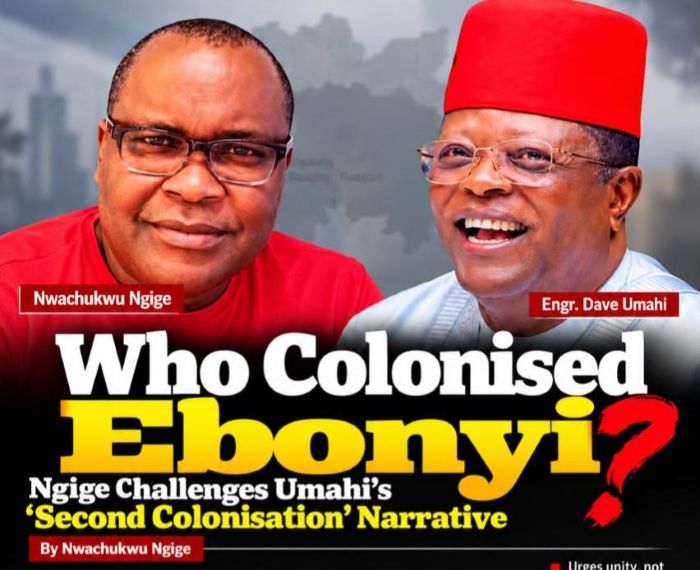
By Nwachukwu Ngige
In a viral video, Minister of Works, David Umahi, exhorted the people of Ebonyi to resist what he described as a return to “Egypt” and a “second colonisation.”
His words were striking. “We will not go back to Egypt. We say no to second colonisation. God has freed us. We have a state of our own and celebrating 30 years of freedom, and nobody will take us back. What happened before was an accident of history. It will not repeat itself.”
Umahi’s argument rests on a historical that the present-day Ebonyi was marginalised since the days of the old Eastern Region till the the creation of Ebonyi State in 1996 liberated them. However, the assertion deserves a more careful interrogation to determine who precisely colonised whom?
Hence, I start by asking whether Dr. Nnamdi Azikiwe, the first Premiere of the Eastern Region, or M.I Okpara who succeeded him marginalised Abakiliki division. Or Sir Francis Akanu Ibiam of Unwana, in present-day Ebonyi State, the Governor of the Region did. Ibiam was no peripheral figure as he occupied the highest regional office in Frist Republic Eastern Nigeria. Probably, Umahi had Dr. Aja Nwachukwu from Okposi, Ebonyi, Minister of Education and later Foreign Affairs in mind?
What of the many sons and daughters of today’s Ebonyi who occupied significant positions in successive governments and institutions in the East Central State, old Anambra and old Enugu State? Consider Senator Ofia Nwali, a distinguished Ezza-born technocrat who represented the Abakaliki zone in the Second Republic Senate and earlier served as Commissioner for Education in East Central State under Ukpabi Asika. Does the marginalisation agents include Engineer Martin Elechi, who also served as a commissioner for Works under Asika and later became Governor of Ebonyi State?
Was Umahi referring to the Ebonyians who served in the successive old Anambra State administrations, the very political structure that today’s narrative appear to portray as that of systematic domination. Among them were Prof. Francis Igboji Idike (Agriculture) Prof. Ozo Nweke Ozo (Works, Lands and later, Agriculture) Daniel Nwagu Ongele (Commerce and Industry) the ebullient Lawrence Nwuruku(Water Resources and Rural Development and later Works /transport ) Then, there was the Doyin of the old Anambra civil service, Icha Ituma, among others. Icha, in particular, was not some obscure functionary.
He rose through the old Anambra civil service to become a permanent secretary, director-general, Sole Administrator of many local governments and later, Deputy Governor of the newly created Enugu State. How could one forget Chris Chukwuma Nwankwo, an Izzi born technocrat who was Secretary to the government of Anambra State in 1986 when I wrote WAEC? What of Hon. Anthony Agbo of Mgbo? Tony was elected into the Enugu State House of Assembly in 1992 and became Speaker at a remarkable age of 27!
The above are no insignificant footnotes, rather, key appointments that rebel against the Umahi’s claim, further raising a fundamental question. If these old political structures were simply instruments of “colonisation” and deliberate suppression of Ndi-Ebonyi, how did many rise to influential positions within those structures? However, that does not also mean that the present-day Ebonyi territory experienced no deprivation.
Such is a common feature across Nigeria and not limited to old Eastern Region and its successor states. But inequality of development is not an automatic proof of ethnic colonisation. This distinction matters. In deed, we can’t wish away the fact that forebears of the present Anambra who saw the light early pioneered development of their area but not at the cost of other areas. It is certainly not at the cost of Ndi-Ebonyi that Obed Azikiwe was secretary to Lord Lugard and fathered the legendry Zik of Africa or that Anambra became the cradle of civilisation as a result of the activities of missionaries who settled there first.
The creation of Ebonyi State in 1996 is to bring government and development closer to the people. Ndi-Igbo are still asking for one more state to bring it at par with other zones. But such should not necessitate the invention of enemies as Umahi canvasses, nor should the legitimate pride of Ndi-Ebonyi in statehood convert to hostility towards fellow Igbo communities. And this is where Umahi’s metaphor of “Egypt” becomes alarmingly problematic, falling flat against the consistent knockings of reason and history.
The biblical Egypt represents bondage while “second colonisation” suggests a deliberate system of domination by an identifiable colonising power. Ironically, Umahi himself says that “what happened before was an accident of history.” A sheer contradiction! Those two propositions do not sit comfortably together.
If something was an “accident of history,” the ordinary meaning is that it arose from historical circumstances and unintended developments rather than from a deliberate conspiracy by a particular people. But his argument is that Anambra and other Igbo communities deliberately conspired to keep Ebonyi underdeveloped. He should therefore produce evidence and not empty emotions wrapped contradictory metaphor.
But the fact is that today’s Ebonyi is not an isolated territory whose people had no dynamic interactions in the old Eastern Region and its successor states. Ndi-Ebonyi were ministers, commissioners, legislators, administrators, professionals and political leaders. It is not simply a story of victimhood. But there is another historical irony which Umahi skewed. The territory that constitutes present-day Ebonyi did not always belong to one administrative unit.
Ohaozara, where Umahi belongs, was at different times in Imo and later Abia before joining Ebonyi in 1996. Reason, his cousin, Ogbonnaya Onu was the first Governor of Abia State. This alone should caution Umahi and all of us against projecting today’s boundaries backwards and interpreting past relationships through the political prism of 2026.
The people of today’s Ebonyi, Anambra and Enugu interacted, intermarried, traded, worked, studied and served together long before the present state boundaries. To therefore reduce that complicated trajectory to “coloniser” and “colonised” is to murder history for contemporary political gains. I’m a historian and it teaches us to be particularly careful when politicians begin to mobilise people through narratives of collective grievance real or imagined.
Cassius understood this psychology when he sought to draw Brutus into the conspiracy against Julius Caesar in B.C 44. Shakespeare captured him manufacturing popular grievance through forged letters presented as expressions of Roman dissatisfaction. The lesson is not that every political grievance is manufactured. It is that collective anger can be mobilised through carefully curated tales of injury. Is Umahi playing Cassius? Again, that is why such injurious historical claims should be tested, not merely chanted.
Ndi-Ebonyi have every right to aspire to the highest office in the country but do not need an invented history of colonisation to justify legitimate aspirations. It doesn’t require the demonisation or turning the sword against Ndi-Anambra. Let’s we forget, there may be more Ndi-Ebonyi living and earning living peacefully in the cities and villages of Anambra than those at home in Ebonyi. Many are accommodated free in many Anambra villages with rights to farm lands.
Need I add that Ezza, Izzi, Mgbo, Ezza-Mgbo, Afikpo, Ohaozara have histories that long predate the creation of Ebonyi State. Their relationships with neighbouring Igbo communities cannot be rewritten simply because contemporary politics finds the language of “Egypt” convenient. The more important issue, therefore, is not who should Ndi-Ebonyi hate? It is for leaders to unite the people around common future rather than lure them into an inheritance of a selectively memorised past. History is too important to be turned into a political weapon.
- Nwachukwu, a journalist writes from Abuja.
