

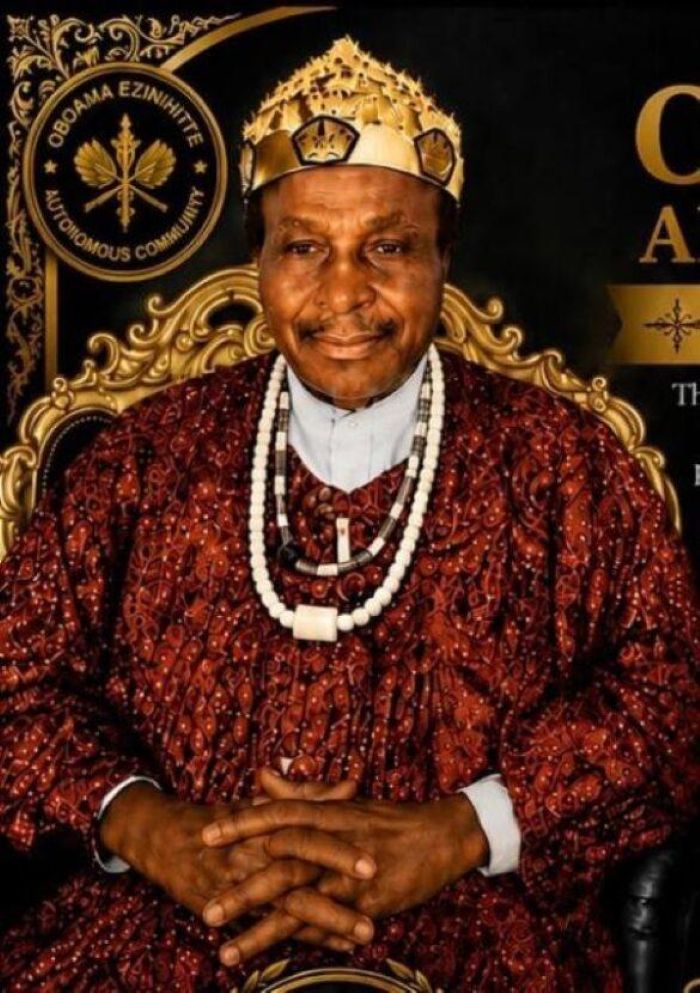
The Late Eze Julius Nnabugwu Amaefuleh, the Aladinma II of Oboama Autonomous Community
By Tony Adibe
Curiously, death has given me this self-imposed task of recounting my several memorable encounters with the highly respected, unassuming, natural diplomat of a monarch, whose thirty-year reign was marked by peace, unity, and socio-cultural and political development of his domain.
Indeed, I have been thinking a great deal since I heard about the passing of His Royal Highness, Eze Julius Nnabugwu Amaefuleh, the traditional ruler and the Aladinma II of Oboama Autonomous Community in Ezinihitte Mbaise Local Government Area of Imo State, South-East, Nigeria.
In my career as a journalist who worked with the Daily Times, National Mirror, Daily Champion and Daily Trust, where I served as the Bureau Chief, South-East Zone, with office in Enugu, I was privileged to have several interviews and memorable interactions with Eze Amaefuleh. Interestingly, my privileged interactions with him taught me humility and sincerity.
His Royal Highness, Eze Amaefuleh, was a peace-loving man, and to the best of my knowledge, he accepted the Ezeship or kingship of Oboama with a view to building peace, unity, and love, as well as cultural, socio-political, and economic growth among the eleven villages and people of Oboama community. I must emphasise that it was in pursuit of these ideals that he anchored or focused his reign, which spanned 30 consecutive years. Some of his contemporaries didn’t last that long on their throne in their various communities!
Eze Amaefuleh was not a power monger nor was he a greedy or selfish leader. Referencing one of his sayings in his usual measured and diplomatic language to me on the issue of the rumoured clamour for division of Oboama by certain people, he said: “I am not against anybody agitating for his own autonomy. I am not opposed to it at all. If the government grants them their request or demand, so be it. But let nobody foment trouble in Oboama because of agitation for autonomy. We need peace more than anything else in this community. Without peace, we cannot have development.” This fact alone shows that Eze Amaefuleh was not the greedy, megalomaniacal kind of traditional ruler, nor was he selfish with power.
“People are free to agitate, and I am not against it. If the government gives them autonomy, so be it, but if the government doesn’t see merit in their demand, will they say Eze Amaefuleh is the cause?” His Highness was unperturbed about the issue.
Truly, I used to be very proud to tell people that my traditional ruler may not have all the money in the world, but His Highness has a good name and integrity. As the Igbo would say, ‘Ezi aha ka ego’ (Good name is better than silver and gold). Proverbs 22:1 says: “A good name is rather chosen than great riches, and loving favour rather than silver and gold.”
Upon reading news of Eze Amaefuleh’s passing in NewsBits, an Abuja-based online news platform, as announced by the Traditional Prime Minister, High Chief Jude Ihuoma, a colleague of mine, resident in Abuja, Oscar Nwogu, sent me a brief WhatsApp message: “Yes, he was among the few revered traditional rulers in Mbaise.” What testimony could be better than that? First Timothy 6:7 says, “For we brought nothing into this world, and it is certain we can carry nothing out.” I think this must have been the guiding principle of the revered Aladinma ii. Eze Amaefuleh never belonged to the rumoured league of 419 native rulers in Mbaise or Imo State, generally speaking. You can go and verify! Perhaps that virtue of his might have contributed to his having lasted 30 unbroken years on the throne. And we hope his successor would emulate his fine qualities.
But still I wonder why death would be so unkind that it didn’t allow His Royal Highness, the Aladinma ii to receive a copy of my latest book, “For The Sake of Our Culture & Other Encounters” (2026) wherein Chapter 5 was devoted to him and the Oboama Community. I had thought of presenting the work to Eze Amaefuleh and calmly watch his infectious and disarming smile as he would admire the literary work from cover to cover flipping through the pages of the book its main theme is the Igbo cultural heritage. Many years ago, His Highness had admired my third literary work when I presented to him a complimentary copy of the book entitled, “Secret Letter To Journalists: A Revealing Insight into Unethical Practices.” (2008).
“There is no kind of professionals Oboama doesn’t have now. This is unlike the past, when people used to laugh at us for lacking well-educated people. I am happy that in my era, Oboama can boast of Engineers, lawyers, doctors, soldiers, journalists like you who are also an author, and even the popular Nollywood actor, Kanayo O. Kanayo is an illustrious son of Oboama community,” Eze Amaefuleh said. “Oboama is going to be greater in the future if our people wouldn’t allow greed and selfishness to take over their reasoning,” he stressed.
“What we shall discourage is any of our children going into crime. Oboama never spared criminals. If you ask De Anthony, your father, he will tell you how Oboama used to handle criminals in those days. There is no indication that our community is now pampering criminals. Therefore, we have not changed,” he added.
In spite of the fact that Eze Amaefuleh was the Traditional Ruler, he was humble enough to recognize those who were his seniors in age, for he addressed my father as ‘De Anthony’!. This, in my view, was a true demonstration of a leader who was never power-drunk or pig-headed! I told him that my maternal home people, Nguru, used to tell me about their phobia for Oboama community because they compared us with Ngwa people in Abia State that naturally never pitied criminals! Eze Amaefuleh smiled and said, “Well, Tony, your maternal home people are entitled to their opinions.” He was quick to conclude by reiterating: “Oboama is going to be greater in the future if we Oboama people don’t allow greed and selfishness to take over our reasoning.”
But how shall I reflect on the monarch, who took me by his hand and said politely, “Tony, follow me; there’s something I would like to show you and your brother, Ikechi?” Mr. Ikechi Nwachukwu, an agriculturist and a notable teacher, had joined me for an ‘interactive visit’ to the Aladinma ii. Upon realizing that Ikechi is an agriculturist, the Aladinma ii got excited. He was always interested in discussing agriculture. His wife, Ugoeze Joan Amaefuleh, is also a graduate of agriculture. “The world can’t do without agriculture because everybody needs food,” Eze Amaefuleh would say to whoever cared to listen. How shall I retell the stories His Royal Highness told me concerning how he acquired some of his farms, and why we, his subjects, should emulate him by investing ‘our hard-earned money’ in profitable ventures rather than lavish it on frivolities or vanities?
How shall I reflect on the monarch who welcomed me to his residence at Aladinma Housing Estate, Owerri many years back? He had expressed excitement that one of his subjects took the pain and stress of writing a book; travelled all the way from Enugu to see him, but politely declined the presents I brought to him to seek his approval before I could include his name as “Royal Father of the Day” on the invitation card of the public presentation of my third book, “Secret Letter To Journalists: A Revealing Insight Into Unethical Practices”?
‘‘It’s not in my character to collect such gifts or presents from my subjects. I maintain it as a policy. If any of my subjects wants me to sign any document for him or her, I will not collect a gift or money for signing the paper. It’s a policy I made, and I will maintain it till my creator calls me home. If any of my subjects wants any favour or service from me, and it’s something I can do, be sure Eze Amaefuleh will do it without collecting anything, be it money or gift,” he said with absolute finality. “There are some traditional rulers who will charge their subjects before signing papers for them. I don’t belong to that group. You can find out from others,” he said. When I later told my father, Anthony Chimezie Adibe (now deceased), about my experience with Eze Amaefuleh, he confirmed the position of the Aladinma ii.
“Eze Amaefuleh would feel embarrassed when you present a gift to him in respect of any event you want to do or any service you want him to render to you. He doesn’t collect kobo from any of his subjects. That’s his own style,” my father said.
I reminded my father of my experience with Eze Amaefuleh’s predecessor, the late Eze Benedict Nwokoleme, the Aladinma i, who demanded and collected money for signing an ‘identification form’ when I wanted admission at the Federal College of Arts & Science Aba at that time. Eze Nwokoleme even told me to go home and ‘use ekete’ (basket) to bring more money for him. My father laughed and said that each Eze has his own style of administration, just like Governors. I agreed with my father!
How shall I reflect on Eze Amaefuleh, who granted me several newspaper interviews, and, in each session, he spoke with a high sense of sincerity and humility? How shall I recall the story the Aladinma ii told me about the feat he achieved? Perhaps, he was not sure any other Oboama indigene or Ezinihitte or Mbaise person has recorded a similar daring act: He drove from Aba to Lagos and drove back to Aba the same day; something that gave his white boss and other staff of R.T.Briscoe a huge, pleasant surprise and earned him accolades and subsequent promotion!
“The road to Lagos was not as wide as it is today. And armed robbery or insecurity was not the order of the day as it is these days. I was asked to go get a particular component that was needed by one of our valued customers. I drove myself because I was much younger then. And I arrived in Lagos before 2:00pm and as soon as I was given the component, I hit the road running again. The issue of traffic gridlock was ruled out; also, the challenge of too many security checkpoints was almost absent. And there were not too many vehicles on the road in those days,” the Aladinma ii recounted.
In my next piece, I shall take the reader through the trip of the memorable 25th (Silver Jubilee) anniversary celebration of Eze Amaefuleh’s reign on the enviable throne, just to refresh our memories and make us appreciate the reason why the Aladinma ii enjoyed criticisms, even when some leaders hate being criticized, however constructive the criticism may sound.
But before then, my prayer, just like the prayer of the other faithful, is that God Almighty will pardon his shortcomings and have mercy on the gentle soul of His Royal Highness, Eze Julius Nnabugwu Amaefuleh, the Traditional Ruler and the Aladinma II of Oboama Autonomous Community in Ezinihitte Mbaise LGA, Imo State, Southeast Nigeria, as he joined his ancestors.
